IMF sees resilient Lithuanian growth but warns of mounting fiscal and structural pressures
Lithuania’s economy has remained resilient despite a difficult external environment, but sustaining convergence with richer EU economies will increasingly depend on shifting from demand-driven growth towards investment and productivity, according to the IMF’s 2026 Article IV review. GDP grew by 2.9% in 2025 and is projected to expand by 2.8% in 2026, supported by strong wage growth, fiscal expansion, EU-funded investment and additional household consumption linked partly to Pillar II pension withdrawals. However, inflation is expected to temporarily rise to 5.2% in 2026, reflecting higher energy prices, continued strong domestic demand and Lithuania’s dependence on imported energy.
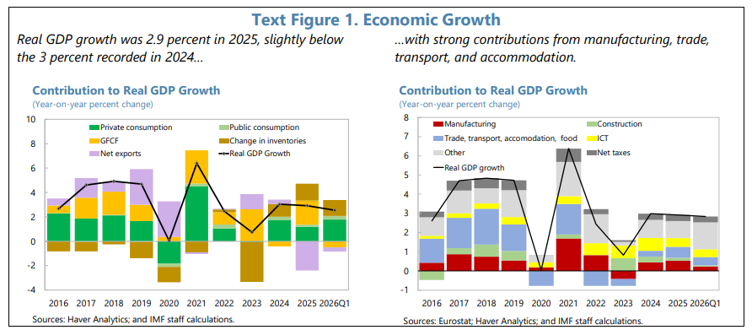
Figure 2. Lithuania: real GDP growth and contributions to growth.
Source: IMF, Republic of Lithuania: 2026 Article IV Consultation, IMF Country Report No. 26/191, July 2026, Text Figure 1. Sources underlying the IMF figure: Eurostat, Haver Analytics and IMF staff calculations.
The IMF identifies fiscal sustainability as a growing medium-term challenge. Public debt increased to 39.5% of GDP in 2025 and is projected to rise further as expenditure pressures increase; without policy action, the Fund estimates debt could reach 60% of GDP by 2033. It therefore calls for a medium-term fiscal strategy centred on stronger revenue mobilisation and more efficient spending. The IMF also calls for a comprehensive reassessment of Lithuania’s multi-pillar pension system following recent changes that weakened Pillar II, warning that these could lower future replacement rates and increase fiscal costs as demographic pressures intensify. In the near term, it recommends preserving Pillar I reserves and maintaining state contributions to Pillar II to support stability and participation.
Looking beyond the near-term outlook, the IMF argues that Lithuania’s next growth phase will depend increasingly on addressing weak productivity growth, population ageing, labour and skills shortages, and regional disparities. Priorities include deeper domestic and EU capital markets, greater non-bank financing, stronger innovation and digital adoption, better alignment between skills and labour-market needs, and further investment in renewable energy, grids and transport. The Fund also calls for deeper integration into the EU single market for capital, labour and products.
The message is therefore relatively balanced: Lithuania continues to outperform despite external pressures, but maintaining that momentum will require converting strong domestic demand and EU-supported investment into more durable productivity-led growth if the country is to sustain its longer-term convergence with the euro area.
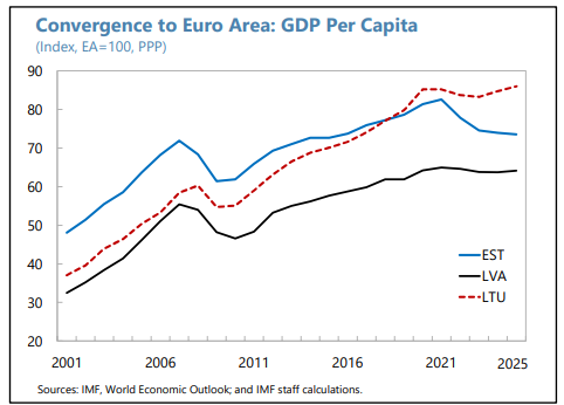
Figure 3. Lithuania's GDP-per-capita convergence with the euro area, compared with Estonia and Latvia.
Source: IMF, Republic of Lithuania: 2026 Article IV Consultation, IMF Country Report No. 26/191, July 2026. Sources underlying the IMF figure: IMF World Economic Outlook and IMF staff calculations.
Romania holds rates at 6.5% as inflation eases but underlying pressures persist
The National Bank of Romania (BNR) kept its key policy rate unchanged at 6.50% on 10 August, maintaining a cautious stance amid persistent domestic price pressures and a weak economic backdrop. At the time of the decision, the BNR noted that annual inflation had declined to 10.42% in June, while adjusted CORE2 inflation remained elevated at 8.3%. The latest data published by the National Institute of Statistics two days later showed a further significant moderation, with annual CPI inflation falling to 8.2% in July, although prices still increased by 0.6% month-on-month. The composition remains uneven: food prices were 5.0% higher year-on-year and non-food goods 7.9%, while services prices increased by 13.7%, pointing to persistent underlying domestic price pressures.
The BNR nevertheless expects inflation to decline substantially during Q3 2026 as the effects of previous energy-price, VAT and excise-duty increases fade, before returning within its target range by the end of 2027. The challenge is that disinflation is occurring alongside weak economic activity: GDP contracted by 1.2% year-on-year in Q1, although the central bank sees signs of a modest recovery during Q2 and Q3. For markets, the combination of still-high services inflation, fiscal consolidation and subdued growth leaves the BNR with limited room for rapid monetary easing. The Bank also stresses that EU and RRF fund absorption will be critical to cushioning the contractionary effects of fiscal adjustment and supporting investment, reinforcing the importance of EU-funded capital expenditure to Romania's near-term growth outlook.
Estonia’s fund assets rise sharply, but pension capital remains predominantly invested abroad
Estonia’s investment and pension fund assets reached €11.8 billion at the end of Q2 2026, increasing by 11% during the quarter and 24% year-on-year, according to Eesti Pank. Pension funds accounted for the large majority, with second- and third-pillar assets reaching €9.08 billion. Second-pillar assets rose 28% year-on-year to €7.74 billion, while third-pillar assets expanded particularly strongly, increasing 45% to €1.34 billion. Eesti Pank attributes much of the overall increase to rising investment values rather than new inflows alone: second- and third-pillar funds recorded average nominal annual returns of 22% and 24% respectively, while funds overall received €112 million in net payments during Q2.
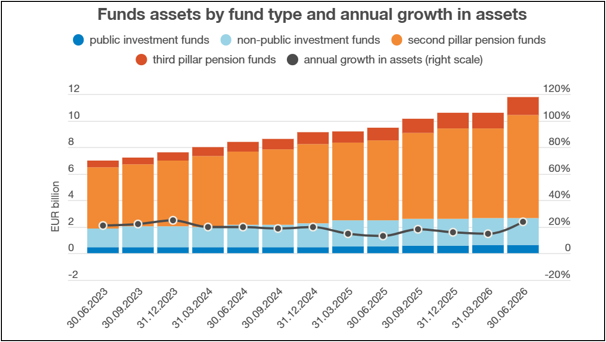
Figure 4. Assets of Estonian investment and pension funds by fund type and annual asset growth, Q2 2023–Q2 2026.
Source: Eesti Pank, Statistics on investment and pension funds, Q2 2026, 11 August 2026.
The figures also highlight a significant shift towards index-based investing. Index funds now account for 35% of second-pillar assets, up five percentage points over the year, and as much as 62% of third-pillar assets. Yet the growing pool of pension savings is only weakly connected to domestic investment: just 9% of second-pillar and 3% of third-pillar investments were invested in Estonia, with both shares declining over the previous year. This creates an interesting angle for the wider Savings and Investments Union debate. Estonia has succeeded in building a sizeable and rapidly growing pool of long-term household savings, but relatively little of this capital is currently channelled into its own economy. The challenge is therefore not simply to increase savings, but to deepen domestic and regional investment opportunities capable of attracting institutional capital without compromising diversification or returns.
Czech inflation remains subdued despite renewed fuel and services pressures
Czech inflation accelerated moderately in July but remained low by regional standards. According to final data from the Czech Statistical Office (CZSO), consumer prices increased by 1.7% year-on-year, up from 1.5% in June, and by 0.6% month-on-month. The acceleration was driven partly by transport costs, with fuel and lubricant prices rising 16.8% year-on-year, while housing-related costs also continued to increase. These pressures were partly offset by falling food prices, including substantial year-on-year declines in several food categories. On the EU-comparable HICP measure, Czech inflation was even lower at 1.3%, compared with a preliminary 2.9% for the euro area.
The headline figure nevertheless masks a pronounced divergence between goods and services. Goods prices fell by 0.2% year-on-year, while services increased by 4.7%, with restaurant services up 4.0%, accommodation 6.4% and actual rents 6.1%. This suggests that while overall inflation is contained, more persistent domestically driven price pressures have not disappeared. For monetary policy, the combination of below-target headline inflation and elevated services inflation supports a cautious approach: the Czech economy has achieved substantial disinflation, but the composition of price growth provides less justification for rapid monetary easing than the 1.7% headline figure alone might suggest.
Czechia provides a useful contrast with economies such as Romania, where July inflation remained at 8.2%. Increasingly divergent inflation profiles across CEE mean that the region can no longer be viewed as moving through a common monetary cycle. Differences in services inflation, wages, energy and food prices, domestic demand and fiscal conditions are likely to produce increasingly country-specific interest-rate paths, with direct implications for corporate financing costs, credit conditions and investment decisions across the region.