
The EU’s Market Integration and Supervision Package aims to deepen capital market integration, reduce fragmentation, and strengthen supervisory convergence across Europe. For Central and Eastern Europe, the picture is more mixed.

Topics
Article Content
Will the EU’s market integration agenda deliver equally for CEE?
Summary
The European Commission’s Market Integration and Supervision Package (MISP), proposed as part of the Savings and Investments Union (SIU), aims to deepen capital market integration and strengthen supervisory convergence across the EU. While the package seeks to reduce fragmentation and facilitate investment, its effects may differ across Central and Eastern Europe, where financial systems remain smaller and more bank-based than in Western Europe.
Setting the scene: MISP and CEE
Presented by the European Commission on 4 December 2025, the Market Integration and Supervision Package (MISP) is a central initiative under the Savings and Investments Union (SIU). The package seeks to reduce fragmentation, facilitate cross-border investment activity and strengthen supervisory convergence across EU capital markets.
The package consists of proposals for a Master Regulation, a Master Directive as well as a Settlement Finality Regulation (SFR). Its objective is to strengthen market integration, improve competitiveness and support investment in Europe’s strategic priorities.
However, while the package is designed at EU level, its implications are unlikely to be evenly distributed across Member States. In particular, Central and Eastern European (CEE) countries face a distinct set of structural characteristics that may shape both the opportunities and risks arising from deeper market integration and supervisory centralisation.
CEE markets start from different positions
CEE financial systems generally remain smaller, more bank-based and less capital-market-oriented than those of many Western European economies. Equity market capitalisation, institutional investor bases and domestic asset-management sectors also tend to be less developed across much of the region.
Figure 1. Market capitalisation of listed domestic companies (% of GDP), selected EU Member States, 2024
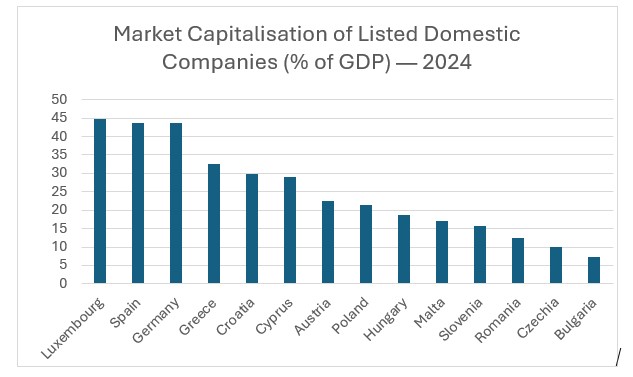
Figure 1 shows differences in capital market development across EU Member States. Several CEE countries continue to exhibit lower market capitalisation relative to GDP than larger Western European markets. Source: World Bank, Market capitalisation of listed domestic companies (% of GDP), 2024.
This creates a structural difference within the SIU agenda. While larger Western European markets may benefit more immediately from increased scale and cross-border consolidation, smaller CEE markets may face greater challenges in attracting investment if integration primarily reinforces existing financial centres.
The MISP therefore raises an important strategic question for the region: whether deeper integration will improve access to capital for smaller markets or contribute to greater concentration within Europe’s largest financial centres.
The debate around ESMA’s expanding role
One of the most politically sensitive aspects of the package concerns the expansion of ESMA’s direct supervisory powers. The proposal would expand ESMA’s role in supervising certain significant cross-border market actors, including Pan-European Market Operators (PEMOs), crypto-asset service providers (CASPs), significant central counterparties (CCPs), and significant central securities depositories (CSDs), alongside broader measures aimed at strengthening supervisory convergence across EU financial markets.
The package also proposes reforms to ESMA governance through the establishment of a stronger Executive Board.
Figure 2. Simplified overview of market infrastructure and supervisory architecture under the Market Integration and Supervision Package
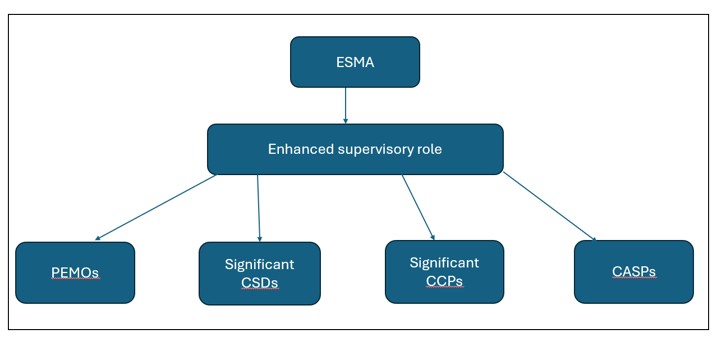
Figure 2 illustrates the proposed supervisory architecture under the MISP and the expansion of ESMA's role regarding certain significant cross-border entities. Source: Author illustration based on European Commission MISP proposals.
In its April 2026 opinion on the MISP proposals, the European Central Bank (ECB) welcomed stronger supervisory integration and supported greater EU-level supervision of certain cross-border market actors, arguing that stronger supervisory consistency could help reduce fragmentation and improve risk oversight.
Nevertheless, several smaller Member States have expressed concerns regarding subsidiarity, costs, and the potential marginalisation of national competent authorities (NCAs). For many CEE countries, these concerns are particularly acute. Smaller jurisdictions often rely on NCAs not merely as supervisors but also as key facilitators of domestic market development. A shift toward greater ESMA centralisation may therefore be perceived as reducing national influence over financial-sector development strategies.
At the same time, certain CEE countries, particularly Poland, may benefit from stronger supervisory convergence. As the region’s largest capital market and home to the largest stock exchange in Central and Eastern Europe, Poland may see strategic value in stronger EU-level integration if it strengthens cross-border investment flows and market visibility.
Where could CEE benefit?
The package may also create opportunities for the region. For many CEE economies, investment needs remain significant, particularly in infrastructure modernisation, energy transition projects and innovation-related activities. Deeper capital-market integration could therefore improve access to private capital and support broader investment opportunities across the region.
The package’s broader objective of reducing market fragmentation and improving cross-border market integration may also support the development of regional investment products and improve investor access to diversified investment opportunities. Additionally, measures promoting harmonisation in post-trade infrastructure and settlement could lower transaction costs for smaller markets and improve cross-border participation.
However, benefits will likely depend on proportionality and implementation. Excessively centralised or administratively burdensome frameworks may disproportionately affect smaller market participants with more limited compliance capacities.
Looking ahead
The MISP reflects the EU’s broader ambition to deepen financial integration and strengthen the Savings and Investments Union. The proposals are currently under discussion in Council and Parliament, with debates focusing particularly on ESMA powers, governance reforms and the scope of direct supervision.
For CEE countries, however, the impact of the package may differ depending on market structures and supervisory capacity. While greater integration could improve access to investment and modernise market infrastructure, ensuring proportionality will remain essential to avoid reinforcing existing disparities across European financial markets.
The challenge for policymakers will therefore be to deepen integration while ensuring that Europe’s smaller and less developed markets are able to participate fully in its benefits.
Key takeaways:
· The MISP represents a major step in the EU’s efforts to deepen capital market integration and strengthen supervisory convergence.
· CEE markets could benefit from improved access to capital, more integrated market infrastructure and lower cross-border barriers.
· The effects of the reforms are unlikely to be uniform, as outcomes may vary depending on differences in market size, institutional development and supervisory capacity across the region.
Article Content
Will the EU’s market integration agenda deliver equally for CEE?
Summary
The European Commission’s Market Integration and Supervision Package (MISP), proposed as part of the Savings and Investments Union (SIU), aims to deepen capital market integration and strengthen supervisory convergence across the EU. While the package seeks to reduce fragmentation and facilitate investment, its effects may differ across Central and Eastern Europe, where financial systems remain smaller and more bank-based than in Western Europe.
Setting the scene: MISP and CEE
Presented by the European Commission on 4 December 2025, the Market Integration and Supervision Package (MISP) is a central initiative under the Savings and Investments Union (SIU). The package seeks to reduce fragmentation, facilitate cross-border investment activity and strengthen supervisory convergence across EU capital markets.
The package consists of proposals for a Master Regulation, a Master Directive as well as a Settlement Finality Regulation (SFR). Its objective is to strengthen market integration, improve competitiveness and support investment in Europe’s strategic priorities.
However, while the package is designed at EU level, its implications are unlikely to be evenly distributed across Member States. In particular, Central and Eastern European (CEE) countries face a distinct set of structural characteristics that may shape both the opportunities and risks arising from deeper market integration and supervisory centralisation.
CEE markets start from different positions
CEE financial systems generally remain smaller, more bank-based and less capital-market-oriented than those of many Western European economies. Equity market capitalisation, institutional investor bases and domestic asset-management sectors also tend to be less developed across much of the region.
Figure 1. Market capitalisation of listed domestic companies (% of GDP), selected EU Member States, 2024
Figure 1 shows differences in capital market development across EU Member States. Several CEE countries continue to exhibit lower market capitalisation relative to GDP than larger Western European markets. Source: World Bank, Market capitalisation of listed domestic companies (% of GDP), 2024.
This creates a structural difference within the SIU agenda. While larger Western European markets may benefit more immediately from increased scale and cross-border consolidation, smaller CEE markets may face greater challenges in attracting investment if integration primarily reinforces existing financial centres.
The MISP therefore raises an important strategic question for the region: whether deeper integration will improve access to capital for smaller markets or contribute to greater concentration within Europe’s largest financial centres.
The debate around ESMA’s expanding role
One of the most politically sensitive aspects of the package concerns the expansion of ESMA’s direct supervisory powers. The proposal would expand ESMA’s role in supervising certain significant cross-border market actors, including Pan-European Market Operators (PEMOs), crypto-asset service providers (CASPs), significant central counterparties (CCPs), and significant central securities depositories (CSDs), alongside broader measures aimed at strengthening supervisory convergence across EU financial markets.
The package also proposes reforms to ESMA governance through the establishment of a stronger Executive Board.
Figure 2. Simplified overview of market infrastructure and supervisory architecture under the Market Integration and Supervision Package
Figure 2 illustrates the proposed supervisory architecture under the MISP and the expansion of ESMA's role regarding certain significant cross-border entities. Source: Author illustration based on European Commission MISP proposals.
In its April 2026 opinion on the MISP proposals, the European Central Bank (ECB) welcomed stronger supervisory integration and supported greater EU-level supervision of certain cross-border market actors, arguing that stronger supervisory consistency could help reduce fragmentation and improve risk oversight.
Nevertheless, several smaller Member States have expressed concerns regarding subsidiarity, costs, and the potential marginalisation of national competent authorities (NCAs). For many CEE countries, these concerns are particularly acute. Smaller jurisdictions often rely on NCAs not merely as supervisors but also as key facilitators of domestic market development. A shift toward greater ESMA centralisation may therefore be perceived as reducing national influence over financial-sector development strategies.
At the same time, certain CEE countries, particularly Poland, may benefit from stronger supervisory convergence. As the region’s largest capital market and home to the largest stock exchange in Central and Eastern Europe, Poland may see strategic value in stronger EU-level integration if it strengthens cross-border investment flows and market visibility.
Where could CEE benefit?
The package may also create opportunities for the region. For many CEE economies, investment needs remain significant, particularly in infrastructure modernisation, energy transition projects and innovation-related activities. Deeper capital-market integration could therefore improve access to private capital and support broader investment opportunities across the region.
The package’s broader objective of reducing market fragmentation and improving cross-border market integration may also support the development of regional investment products and improve investor access to diversified investment opportunities. Additionally, measures promoting harmonisation in post-trade infrastructure and settlement could lower transaction costs for smaller markets and improve cross-border participation.
However, benefits will likely depend on proportionality and implementation. Excessively centralised or administratively burdensome frameworks may disproportionately affect smaller market participants with more limited compliance capacities.
Looking ahead
The MISP reflects the EU’s broader ambition to deepen financial integration and strengthen the Savings and Investments Union. The proposals are currently under discussion in Council and Parliament, with debates focusing particularly on ESMA powers, governance reforms and the scope of direct supervision.
For CEE countries, however, the impact of the package may differ depending on market structures and supervisory capacity. While greater integration could improve access to investment and modernise market infrastructure, ensuring proportionality will remain essential to avoid reinforcing existing disparities across European financial markets.
The challenge for policymakers will therefore be to deepen integration while ensuring that Europe’s smaller and less developed markets are able to participate fully in its benefits.
Key takeaways:
· The MISP represents a major step in the EU’s efforts to deepen capital market integration and strengthen supervisory convergence.
· CEE markets could benefit from improved access to capital, more integrated market infrastructure and lower cross-border barriers.
· The effects of the reforms are unlikely to be uniform, as outcomes may vary depending on differences in market size, institutional development and supervisory capacity across the region.