Newsletter 31 August 2026

CEE Perspective Weekly Digest - Issue 12

CEE Perspective Weekly Digest - Issue 12

What's on the table this week

Europe’s financial-policy agenda is accelerating again after the summer break, but developments across CEE point to an increasingly differentiated regional picture. Lithuania is experiencing double-digit growth in both credit and deposits, while in Romania inflation is eroding nominal lending growth and banks’ exposure to government is expanding faster than private-sector credit. Croatia, meanwhile, continues to grow, but at a noticeably slower pace.

These divergences matter as EU policymakers turn their attention back to mobilising savings, deepening capital markets and strengthening competitiveness. The region also features prominently in the emerging race for AI infrastructure, with Warsaw, Prague and Bucharest ranking among the global markets with the strongest potential for future data-centre development. Across these developments, a common question is emerging: how effectively can CEE economies translate domestic savings, financial intermediation and infrastructure advantages into productive investment and stronger long-term growth?

Recent Key EU Developments

1

Commission asks ESMA to prepare the next stage of the Retail Investment Strategy


The European Commission askedESMA for technical advice on the implementation of key parts of the EU’s Retail Investment Strategy (RIS), moving the reform into its detailed rulemaking phase. The request covers amendments to MiFID II, UCITS and AIFMD, with ESMA expected to deliver most of its advice by 1 October 2027. The Commission currently expects the RIS to be formally adopted and published by January 2027, with most provisions applying from around July 2029. 

A major focus will be the new value-for-money framework. ESMA is being asked to develop criteria for comparing retail investment products with relevant peer groups, including how costs, charges and performance should be assessed and when a product should be considered a significant outlier. The mandate also covers inducements, suitability and appropriateness tests, a new simplified advice regime for well-diversified, non-complex and cost-efficient products, marketing and finfluencers, and rules preventing undue costs in UCITS and AIFs. 

The Commission is also explicitly asking ESMA to reconcile stronger investor protection with simplification and burden reduction. This matters because the effectiveness of the RIS will increasingly depend not on the Level 1 political agreement, but on how concepts such as value for money, peer-group comparisons and simplified advice are translated into operational rules. 

What this means for CEE markets: Smaller CEE investment markets may have fewer comparable products and less developed distribution ecosystems than larger Western European markets. A peer-group methodology designed primarily around deep, mature markets could therefore produce distorted comparisons or disproportionately classify products in smaller markets as outliers. The Commission has recognised this risk by asking ESMA to account for market size and allowing alternative criteria where meaningful peer groups cannot be constructed. How ESMA operationalises that flexibility will be one of the most important RIS implementation questions for smaller EU capital markets. 

EBA consults on when large investment firms should be treated as banks

The European Banking Authority (EBA) has launched a consultation on draft technical standards governing when large investment firms may need to be reclassified as credit institutions. The rules concern firms carrying out certain dealing-on-own-account and underwriting or placing activities and specify how the €30 billion asset threshold triggering a banking-authorisation requirement should be calculated and monitored. The consultation runs until 25 November 2026. 

Following changes to the Capital Requirements Directive, the group-level calculation would focus on relevant EU undertakings and their subsidiaries, as well as EU branches of third-country groups, rather than applying globally. The EBA also proposes criteria for supervisors when deciding whether firms crossing the threshold can receive a waiver, including their business model, systemic importance, links to the banking system and the scale and complexity of derivatives activities. The aim is effectively to ensure that bank-like prudential requirements follow bank-like risks rather than size alone. 

What this means for CEE markets: For most domestically focused CEE investment firms, the €30 billion threshold means direct reclassification risk is likely to remain limited. The more relevant issue is for subsidiaries and branches belonging to larger cross-border investment groups. The EU-focused calculation and risk-sensitive waiver mechanism should help avoid firms facing banking requirements simply because they belong to large global groups, while retaining stricter treatment where their European activities create genuine prudential or systemic risks.

CEE Policy Radar

1

Lithuania’s credit growth accelerates even as borrowing costs remain elevated

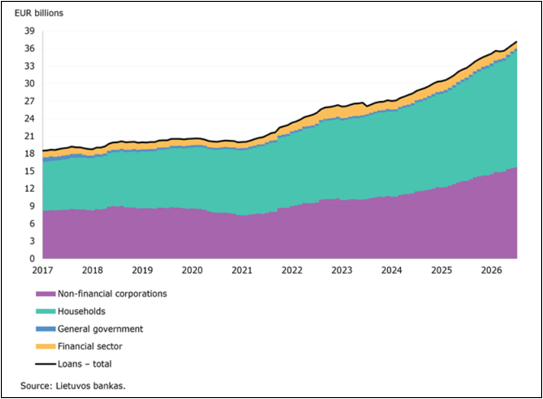
Lithuania’s banking datafor July point to unusually strong activity on both sides of bank balance sheets. Loans to Lithuanian residents grew by 13.2% year-on-year, reaching around €37.3 billion. Corporate lending expanded by 17.3%, while household lending increased by 14.5%. At the same time, resident deposits grew by 13%, with household deposits rising by 16.3% to €30.8 billion. Rather than a credit expansion financed by weakening household liquidity, Lithuania is therefore experiencing rapid growth in borrowing and savings simultaneously.
picture1-1788173911.png

Loans granted by other MFIs to Lithuanian residents, excluding MFIs. Source: Bank of Lithuania. 

The composition of household borrowing deserves particular attention. Mortgage lending grew by 14.1% year-on-year to €16.3 billion, while consumer credit expanded by 27.4%, albeit from a considerably smaller €2.1 billion base. This is happening despite borrowing remaining relatively expensive: new mortgages averaged 4.09% in July and consumer loans 8.36%. Businesses saw some easing, with the average rate on new corporate loans declining to 4.83%, although loans below €1 million remained more expensive at 5.05%. 

The savings side is equally significant. Rates on new household term deposits jumped 44 basis points to 2.22%, yet households still held €22.5 billion in overnight deposits compared with €8 billion in deposits with agreed maturity. Lithuania therefore illustrates an important challenge for the EU’s Savings and Investments Union: the country has a rapidly expanding pool of household savings, but much of it remains in highly liquid bank deposits rather than moving towards longer-term investment products. Strong deposit growth gives banks substantial resources to intermediate into lending, but mobilising more of those savings towards capital-market investment remains a separate policy challenge. 

CEE cities emerge as potential hubs for the next wave of AI data centres

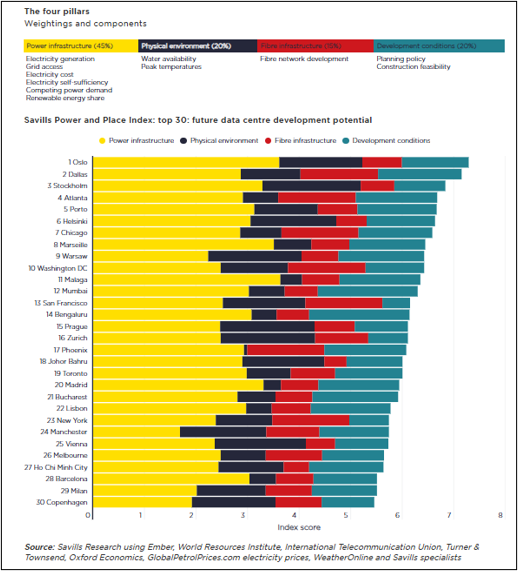
Central and Eastern Europe is emerging as a potential destination for the next wave of data-centre investment driven by artificial intelligence. A new Savills Power and Place Index places Warsaw 9th, Prague 15th and Bucharest 21st globally for future data-centre development potential. The index assesses 54 markets according to factors including power availability and costs, digital connectivity, water and climate conditions and project-delivery conditions. Crucially, the ranking measures future development feasibility rather than existing market size or guaranteed investment.
picture2-1788173939.png

Source: Savills Research, Power and Place Index, August 2026, using data from Ember, World Resources Institute, International Telecommunication Union, Turner & Townsend, Oxford Economics, GlobalPetrolPrices.com, WeatherOnline and Savills specialists. 

The opportunity partly reflects constraints in Europe’s established data-centre hubs. AI workloads require increasingly large amounts of electricity, while grid-connection delays, power costs and land constraints are making expansion more difficult in some mature markets. CEE cities able to combine available land and digital connectivity with sufficient electricity infrastructure could therefore attract investment that might previously have concentrated elsewhere in Europe. 

But ranking highly does not guarantee that investment will materialise. Converting CEE’s theoretical advantage into projects will depend heavily on whether governments and network operators can expand grid capacity while maintaining reliable and competitively priced electricity. Large data centres will also compete for power and infrastructure with industrial electrification and other investment projects. The region’s AI infrastructure opportunity is therefore increasingly an energy, grid and investment-policy question as much as a digital one. 

In practice, CEE’s advantage may depend less on relatively low operating costs than on whether governments can accelerate grid investment, connections and project delivery quickly enough to convert investor interest into bankable projects. For Poland, Czechia and Romania, resolving these constraints may ultimately determine how much of Europe’s next data-centre investment cycle they actually capture. 

Romania’s credit growth masks weaker lending in real terms

Romania’s banking sector continues to show nominal credit growth, but high inflation is increasingly changing the underlying picture. According to the National Bank of Romania’s July monetary indicators, non-government credit stood at RON 472.4 billion (€89.9 billion) at the end of July, 7.6% higher than a year earlier. But after adjusting for inflation, lending was 0.5% lower year-on-year, while the stock of credit also declined by 0.3% compared with June. With consumer prices 8.16% higher than a year earlier, nominal balance-sheet expansion is increasingly overstating the strength of underlying credit activity. 

The composition of lending reinforces that picture. Leu-denominated credit, around two-thirds of non-government lending, increased only 3.6% year-on-year and contracted by 4.2% in real terms. Foreign-currency lending, by contrast, increased 16.6% in lei terms, including 20.5% growth in FX credit to companies and other non-household borrowers. At the same time, banks’ claims on the public sector reached RON 286.1 billion, up 12.6% year-on-year, including almost RON 236 billion of government securities. 

Liquidity remains substantial: non-government resident deposits reached RON 684.6 billion and increased 7.8% year-on-year, although they too declined slightly in real terms. The important issue is therefore not banking-system funding, but where balance-sheet growth is occurring. Foreign-currency lending and exposure to government are expanding considerably faster than domestic-currency private-sector credit. If sustained, that pattern could become increasingly relevant for the financing of productive private investment, particularly as Romania simultaneously faces fiscal consolidation pressures and elevated inflation. 

Croatia's economic growth slows to 1.7% in the second quarter

Croatia’s economy expanded by 1.7% year-on-year in Q2 2026, down from 2.2% in the first quarter and 3.8% in Q2 2025. The official estimate broadly confirms the earlier 1.8% projection from the Institute of Economics Zagreb and points to a clear moderation from the strong growth rates recorded over recent years. 

The composition of growth suggests softer domestic momentum. Household consumption increased only 0.5% year-on-year, while government consumption grew by 2%. Exports of goods and services rose 3%, but imports increased slightly faster at 3.4%. Tourism indicators had also weakened in June, even as industrial production, VAT revenues and real retail trade showed some monthly improvement. 

The slowdown does not imply that Croatia has stopped growing, but it does suggest that the exceptionally strong post-pandemic expansion is normalising. The key question is increasingly what replaces consumption and tourism as marginal growth drivers. Sustained investment, productivity gains and effective deployment of EU funding will become more important if Croatia is to maintain rapid convergence as household demand normalises and external conditions remain uncertain. 

Our takeaway:

The latest data underline why CEE increasingly needs to be viewed as a collection of distinct financial markets rather than a single macroeconomic bloc. Lithuania is experiencing double-digit household and corporate credit growth alongside rapid deposit accumulation, Romania’s nominal lending expansion largely disappears after adjusting for inflation and Croatia is seeing economic growth moderate as domestic demand loses momentum. The differences reflect increasingly country-specific combinations of inflation, monetary conditions, household demand and financial intermediation. For investors and policymakers, that divergence means regional averages are becoming less informative: the composition and real value of growth increasingly matter as much as headline rates.


This Week's Events to Watch

1
  • 1 September - Eurostat flash inflation estimate and unemployment data: Eurostat will publish its flash estimate of euro-area inflation for August alongside July unemployment figures. Beyond the headline euro-area number, country-level differences will be worth watching, particularly across CEE euro-area members, as divergent inflation dynamics increasingly shape national financing conditions and the transmission of ECB policy.

  • 1 September - Hungary Q2 GDP second estimate: The Hungarian Central Statistical Office will provide a fuller breakdown of Q2 growth following its flash estimate. Particular attention should be paid to household consumption and investment, which will help show whether domestic demand is strengthening sufficiently to support growth as the Magyar Nemzeti Bank navigates the trade-off between economic weakness and inflation risks.

  • 1, 2 and 4 September - Council financial-services negotiations resume: EU Financial Services Attachés return to three major files during the first week of September. On 1 September, discussions will focus on the asset-management elements of the Market Integration and Supervision Package (MISP), followed on 2 September by negotiations on the ESMA Regulation component of MISP. On 4 September, attention shifts to the digital euro. The concentrated schedule makes this an important first week back for the EU financial-services agenda, with both MISP and the digital euro entering a politically important autumn period.

  • 2 September - European Parliament ECON Committee: ECON returns after the summer with a substantial financial-services agenda. MEPs will hold hearings and votes on senior appointments at ESMA and the EBA, and discuss the reviews of both the Pan-European Personal Pension Product (PEPP) and the IORP framework for occupational pensions. The committee will also exchange views with DG Competition Director-General Anthony Whelan on the review of the EU merger guidelines, State aid and consolidation.

  • 3 September - EBA deadline on 2027 market-risk benchmarking rules: The deadline expires for feedback on amendments to the ITS governing the 2027 market-risk benchmarking exercise. The changes concern benchmarking of internal models and the standardised approach and form part of the continuing implementation of the revised prudential framework. Benchmarking allows supervisors to identify material differences in banks’ model outcomes and potentially unjustified variability in capital requirements.

  • 3–4 September – Informal meeting of European Affairs Ministers: EU European Affairs Ministers will meet in Dublin under the Irish Presidency, with the 2028–2034 Multiannual Financial Framework, enlargement and democratic resilience on the agenda. The first two issues are particularly relevant for CEE: negotiations over the next EU budget will shape future cohesion and investment priorities, while candidate countries will join Member States for a dedicated discussion on enlargement. The meeting will therefore offer an early indication of how the Irish Presidency intends to advance two files with significant implications for the region.

  • 4 September – European Commission College seminar: Commissioners will gather for a College seminar as the Commission resumes work after the summer break. The meeting comes at the start of a busy autumn policy cycle, with major economic and financial-services files, competitiveness, the next EU budget and implementation of the Commission’s simplification agenda all returning to the fore. This will be worth watching for indications of the Commission’s priorities for the months ahead.

CEE Perspective Updates

2

One Region, Different Signals: Introducing CEE Markets Signal 

Central and Eastern Europe is often discussed as a single market, yet the region’s economies rarely move in perfect alignment. Policy choices, financing conditions and investment priorities increasingly differ from one country to another. Capturing these differences requires a format that is comparative, focused and quick to read. This is the idea behind CEE Markets Signal, CEE Perspective’s new biweekly publication. 

Each edition will examine one development emerging across several CEE markets, supported by relevant data and placed within its broader regional context. The publication will cover issues ranging from monetary policy and capital-market developments to pension reform, defence investment and banking profitability, explaining both where countries are diverging and what that means for policymakers, financial institutions and investors. 

The first edition focuses on monetary policy. While Hungary has moved towards easing and Czechia continues to maintain a tighter stance, CEE economies within the euro area remain tied to the ECB’s common interest-rate path. These different trajectories are creating increasingly varied conditions for borrowing, lending and investment across the region. Read the first edition and explore our full range of publications.

Read more

What the Latest CESEE Lending Signals Tell Us

CEE Perspective launched its new Conversations with Experts series on Friday with Matteo Ferrazzi, Principal Advisor and Senior Economist at the European Investment Bank, for an in-depth discussion of the CESEE Bank Lending Survey 2026.

The conversation examined a regional lending environment characterised by resilient credit demand, a more cautious supply outlook and growing attention to credit quality. Matteo placed the survey’s findings within the wider economic context, explaining how banks’ expectations and risk assessments are evolving across Central, Eastern and South-Eastern Europe. The discussion was moderated by Andreea Lungu and enriched by questions from participants.

We thank Matteo for sharing his expertise, Andreea for guiding the exchange and everyone who joined us. The full recording is available on our website and YouTube channel. Conversations with Experts will return in September with a guest from another leading European banking institution.

What the Latest CESEE Lending Signals Tell Us Watch

Also On Our Radar

1
  • EBA consults on new operational risk management framework: The EBA launched a public consultation on technical standards specifying how institutions should identify, assess, monitor and manage operational risk under CRR3. The framework covers governance, risk data, reporting, validation and audit, while ICT risks remain governed by DORA. The important question to watch is how far proportionality will reduce implementation costs for smaller institutions: banks with a business indicator below €750 million would benefit from less frequent reviews and reporting and less granular requirements.

  • CEE credit conditions: The Czech National Bank will publisha substantial batch of July financial-sector statistics on 31 August, including banking statistics, MFI interest rates and monetary data. Following the contrasting signals from Lithuania and Romania, the Czech figures will provide another useful test of how far credit conditions are diverging across CEE as inflation and monetary-policy paths increasingly differ by country.

  • EBA responds to Parliament’s 2024 discharge observations: The EBA published its response to the European Parliament’s observations under the 2024 discharge procedure. The Authority noted that only nine observations directly concerned the EBA and concluded that none require specific follow-up action.