
CEE Markets Signal is a biweekly publication offering concise comparative analysis of one financial or policy development across several CEE markets. Each edition examines how the issue is unfolding across the region and its implications for finance, investment and policymaking.
Article Content
Monetary policy paths diverge across Central and Eastern Europe
Central and Eastern Europe is no longer moving through the monetary policy cycle at the same pace. During July, Hungary continued easing monetary policy, while Czechia maintained the tighter stance established following its June rate increase. Euro-area CEE countries remained subject to the European Central Bank's common monetary policy, with the ECB leaving its key interest rates unchanged in July.
The result is a more heterogeneous financing environment than at any point since the post-pandemic tightening cycle began, with borrowing costs now increasingly reflecting national macroeconomic conditions rather than a common regional trend.
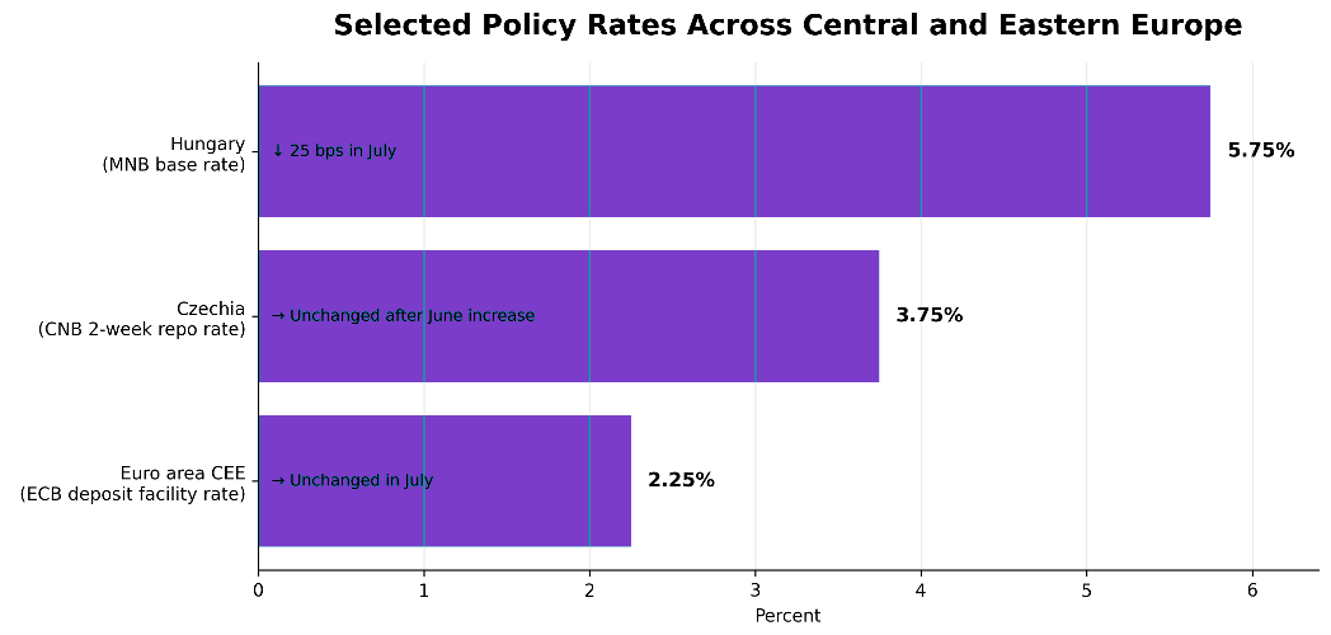
Figure 1. Selected policy rates across Central and Eastern Europe at end-July 2026. Sources: Magyar Nemzeti Bank; Czech National Bank; European Central Bank. Note: The policy rates shown represent different monetary-policy instruments used by the respective central banks. They are presented to illustrate the relative monetary policy stance across Central and Eastern Europe rather than as directly comparable operational rates.
Three signals to watch
1. Hungary has room to ease, but only gradually
The Magyar Nemzeti Bank lowered its base rate to 5.75% with effect from 22 July, continuing its cautious easing cycle. The decision reflected improving inflation dynamics while the MNB continued to emphasise the importance of exchange-rate stability, the fiscal outlook and geopolitical risks in determining future monetary policy.
For Hungarian households and companies, further reductions could gradually improve borrowing conditions. For banks, however, the transition towards lower rates may begin to reduce the unusually strong interest-income tailwinds associated with the previous high-rate environment.
2. Czechia is moving in the opposite direction
The Czech National Bank raised its two-week repo rate to 3.75% in June, citing persistent core inflation, accelerating credit growth and rapid wage increases. The rate remained at that level throughout July, while the subsequent monetary-policy meeting took place on 6 August.
This illustrates that easing inflation does not automatically translate into rate cuts. Where domestic demand, wages or credit growth remain strong, central banks may still judge that tighter monetary conditions are necessary.
3. Euro-area CEE follows a common rate path, but national conditions still differ
The ECB kept its deposit facility rate at 2.25%, reaffirming its data-dependent and meeting-by-meeting approach as uncertainty remained elevated due to the inflation outlook and the ongoing impact of geopolitical tensions on energy markets. The Governing Council also reiterated that future decisions would continue to depend on incoming economic and financial data, underlying inflation dynamics and the strength of monetary policy transmission.
Because Croatia, Slovakia and Slovenia share the euro, ECB decisions directly determine their policy-rate environment, even though domestic growth, inflation and lending conditions continue to differ across those economies.
A common policy rate therefore does not produce identical outcomes. Differences in banking structures, household indebtedness, fiscal policy and credit demand continue to shape how ECB decisions are transmitted within individual CEE markets.
CEE Perspective
The region is entering a more fragmented monetary policy phase. Hungary is gradually reducing interest rates, Czechia has adopted a relatively tighter stance, while the euro-area CEE countries follow monetary policy decisions taken for the currency union as a whole. UniCredit also expects policy paths to remain differentiated, with Hungary continuing its easing cycle, while Poland, Romania and Slovakia are likely to have more limited scope for further rate reductions over the coming quarters.
For companies operating across several CEE markets, this divergence means that financing conditions can no longer be treated as uniform. The cost and availability of credit will increasingly depend on national inflation dynamics, exchange-rate developments and fiscal credibility. For banks, the shift is also likely to reshape profitability: institutions in easing markets may face pressure on net interest margins but benefit from stronger loan demand, while banks operating in relatively tighter monetary environments may preserve higher margins at the expense of slower credit growth.
The broader signal is that Central and Eastern Europe is no longer moving through a single monetary cycle. National macroeconomic conditions are becoming increasingly important in shaping policy decisions, creating more differentiated environments for investment, lending and sovereign financing across the region.
What to watch next
The next signals will come from:
Hungary’s September Inflation Report and any guidance on further easing;
the transmission of the ECB’s July decision to credit conditions in euro-area CEE markets.
Article Content
Monetary policy paths diverge across Central and Eastern Europe
Central and Eastern Europe is no longer moving through the monetary policy cycle at the same pace. During July, Hungary continued easing monetary policy, while Czechia maintained the tighter stance established following its June rate increase. Euro-area CEE countries remained subject to the European Central Bank's common monetary policy, with the ECB leaving its key interest rates unchanged in July.
The result is a more heterogeneous financing environment than at any point since the post-pandemic tightening cycle began, with borrowing costs now increasingly reflecting national macroeconomic conditions rather than a common regional trend.
Figure 1. Selected policy rates across Central and Eastern Europe at end-July 2026. Sources: Magyar Nemzeti Bank; Czech National Bank; European Central Bank. Note: The policy rates shown represent different monetary-policy instruments used by the respective central banks. They are presented to illustrate the relative monetary policy stance across Central and Eastern Europe rather than as directly comparable operational rates.
Three signals to watch
1. Hungary has room to ease, but only gradually
The Magyar Nemzeti Bank lowered its base rate to 5.75% with effect from 22 July, continuing its cautious easing cycle. The decision reflected improving inflation dynamics while the MNB continued to emphasise the importance of exchange-rate stability, the fiscal outlook and geopolitical risks in determining future monetary policy.
For Hungarian households and companies, further reductions could gradually improve borrowing conditions. For banks, however, the transition towards lower rates may begin to reduce the unusually strong interest-income tailwinds associated with the previous high-rate environment.
2. Czechia is moving in the opposite direction
The Czech National Bank raised its two-week repo rate to 3.75% in June, citing persistent core inflation, accelerating credit growth and rapid wage increases. The rate remained at that level throughout July, while the subsequent monetary-policy meeting took place on 6 August.
This illustrates that easing inflation does not automatically translate into rate cuts. Where domestic demand, wages or credit growth remain strong, central banks may still judge that tighter monetary conditions are necessary.
3. Euro-area CEE follows a common rate path, but national conditions still differ
The ECB kept its deposit facility rate at 2.25%, reaffirming its data-dependent and meeting-by-meeting approach as uncertainty remained elevated due to the inflation outlook and the ongoing impact of geopolitical tensions on energy markets. The Governing Council also reiterated that future decisions would continue to depend on incoming economic and financial data, underlying inflation dynamics and the strength of monetary policy transmission.
Because Croatia, Slovakia and Slovenia share the euro, ECB decisions directly determine their policy-rate environment, even though domestic growth, inflation and lending conditions continue to differ across those economies.
A common policy rate therefore does not produce identical outcomes. Differences in banking structures, household indebtedness, fiscal policy and credit demand continue to shape how ECB decisions are transmitted within individual CEE markets.
CEE Perspective
The region is entering a more fragmented monetary policy phase. Hungary is gradually reducing interest rates, Czechia has adopted a relatively tighter stance, while the euro-area CEE countries follow monetary policy decisions taken for the currency union as a whole. UniCredit also expects policy paths to remain differentiated, with Hungary continuing its easing cycle, while Poland, Romania and Slovakia are likely to have more limited scope for further rate reductions over the coming quarters.
For companies operating across several CEE markets, this divergence means that financing conditions can no longer be treated as uniform. The cost and availability of credit will increasingly depend on national inflation dynamics, exchange-rate developments and fiscal credibility. For banks, the shift is also likely to reshape profitability: institutions in easing markets may face pressure on net interest margins but benefit from stronger loan demand, while banks operating in relatively tighter monetary environments may preserve higher margins at the expense of slower credit growth.
The broader signal is that Central and Eastern Europe is no longer moving through a single monetary cycle. National macroeconomic conditions are becoming increasingly important in shaping policy decisions, creating more differentiated environments for investment, lending and sovereign financing across the region.
What to watch next
The next signals will come from:
Hungary’s September Inflation Report and any guidance on further easing;
the transmission of the ECB’s July decision to credit conditions in euro-area CEE markets.