
CEE Markets Signal is a biweekly publication offering concise comparative analysis of one financial or policy development across several CEE markets. Each edition examines how the issue is unfolding across the region and its implications for finance, investment and policymaking.
Article Content
Fragmentation remains a structural constraint on CEE's ability to mobilise investment. Small national markets, limited liquidity and uneven access to investment opportunities restrict their ability to attract capital and offer businesses alternatives to bank financing. Differences in market size and economic structure partly explain this, but divergent supervisory practices and disconnected market infrastructure also make it harder for investors and issuers to operate across borders. Greater regional integration could help smaller markets achieve scale, although the Baltic experience suggests that progress takes time.
The challenge is therefore not simply to expand individual markets, but to make them more connected and attractive to investors and issuers. Recent regional and EU initiatives provide a test of whether greater integration can translate into deeper, more liquid capital markets.
Four signals to watch
1. CEE Region - EBRD puts CEE market fragmentation under the spotlight
The EBRD launched a regional initiative on 17 September covering Bulgaria, Croatia, Hungary, Poland, Romania, Slovakia and Slovenia. It will examine differences in the application and enforcement of EU financial rules, supervisory practices and operational barriers to cross-border investment. Average equity market capitalisation across the seven countries is below 15% of GDP, compared with 68% across the EU, with national figures ranging from 1.5% in Slovakia to 30% in Croatia.
The project will explore closer regulatory and market-infrastructure links, building on cooperation between stock exchanges and central securities depositories. The EBRD identifies limited IPO activity, low liquidity and fragmented infrastructure as obstacles to investment and non-bank financing, particularly for SMEs and start-ups. The initiative aligns with the EU Savings and Investments Union (SIU) and Market Integration and Supervision Package (MISP).
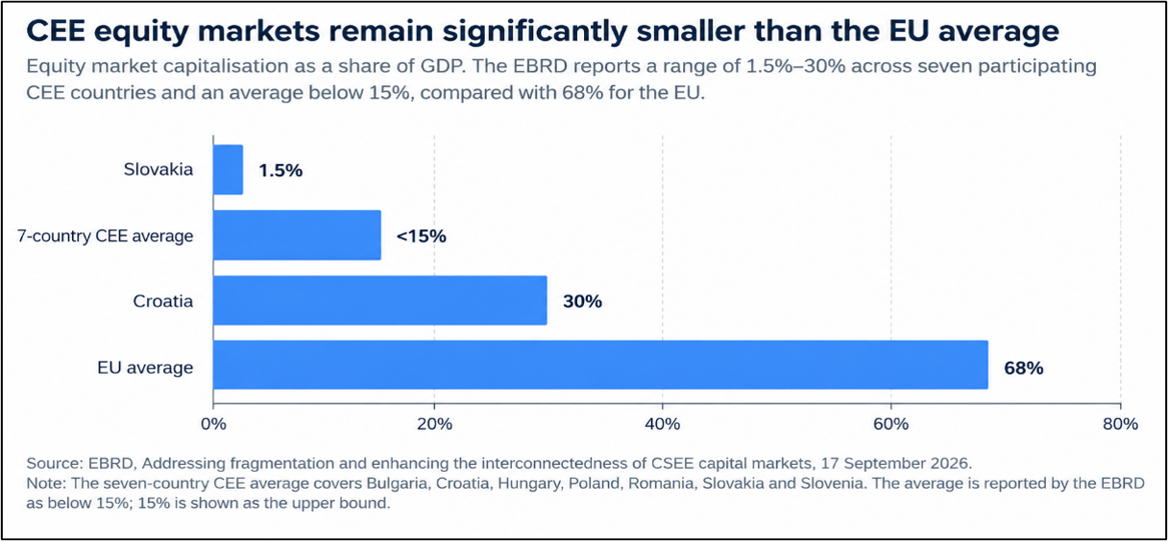
Equity market capitalisation as a share of GDP. The CEE average covers Bulgaria, Croatia, Hungary, Poland, Romania, Slovakia and Slovenia. Note: The EBRD reports an average below 15%; 15% is shown as the upper bound. Source: European Bank for Reconstruction and Development, September 2026.
2. The Baltics - A test case for regional capital-market integration
Estonia, Latvia and Lithuania have worked with the EBRD since 2017 to develop a more integrated capital market. Cooperation has helped align frameworks for covered bonds and commercial paper, while a single MSCI Frontier Markets classification in 2023 increased the region’s visibility among international investors.
In June 2026, the EBRD and the three countries renewed their partnership to mobilise investors, encourage cross-border activity and improve access to finance and listings. The longer-term ambition is MSCI Emerging Market status. There are tangible signs of market development: according to the EBRD, Baltic companies issued €6.68 billion in bonds in 2025, more than double 2024 volumes, with nearly 40% of issuers accessing markets for the first time. Yet deeper, more liquid markets require sustained effort.
3. Latvia expands its investment-services ecosystem
On 17 September, Latvijas Banka announcedthat it had granted an investment firm licence to IBC INVEST, authorising services including portfolio management, order execution and the placement of financial instruments. This was the third such licence issued in Latvia in 2026, bringing the total number of authorised investment firms to 13. While limited in scale, the development highlights the importance of strengthening domestic financial markets alongside regional integration. A broader range of investment intermediaries can improve access to financial services and support market participation, although the impact on liquidity and cross-border investment will depend on how these services develop in practice.
4. EU level - Tackling fragmentation beyond national borders
At EU level, efforts to address market fragmentation are also gaining momentum. The Commission’s proposed Market Integration and Supervision Package seeks to remove barriers to cross-border financial activity, facilitate more integrated trading and post-trading infrastructure, and strengthen supervisory convergence.
These objectives are also reflected in ESMA’s 2027 Work Programme, published on 28 September, which places greater emphasis on implementing the Savings and Investments Union through simplification, supervisory convergence and market integration. For smaller CEE markets, the key question is whether these EU-level initiatives will complement regional integration efforts by reducing practical barriers to cross-border investment and improving access to larger pools of capital.
CEE Perspective analysis
The EBRD initiative and Baltic experience point to a common lesson: greater regional connectivity can help smaller capital markets overcome some of the limitations of operating individually. By reducing cross-border barriers and widening investor access, integration could create opportunities for businesses to raise capital beyond their domestic markets.
Yet integration is an enabler, not a solution in itself. Common frameworks and connected infrastructure cannot compensate for a lack of issuers or sustained investor demand, nor will integration deliver the same benefits across markets at different stages of development. The opportunity for CEE is not to turn every national market into a financial hub, but to make the region more investable as a whole. Success will ultimately depend on whether businesses can raise capital more easily, investors can access opportunities across borders, and smaller markets can achieve a scale they cannot reach individually.
What to watch next
The next signals to watch include:
· EBRD: Findings from its assessment of regulatory, supervisory and operational barriers to cross-border investment across the seven CEE markets;
· Baltic integration: Progress in attracting new issuers and investors to the pan-Baltic market;
· EU framework: The outcome of MISP negotiations and implications for market infrastructure and supervision;
· Market impact: Evidence that greater integration is translating into deeper liquidity, more cross-border investment and improved access to capital.
Article Content
Fragmentation remains a structural constraint on CEE's ability to mobilise investment. Small national markets, limited liquidity and uneven access to investment opportunities restrict their ability to attract capital and offer businesses alternatives to bank financing. Differences in market size and economic structure partly explain this, but divergent supervisory practices and disconnected market infrastructure also make it harder for investors and issuers to operate across borders. Greater regional integration could help smaller markets achieve scale, although the Baltic experience suggests that progress takes time.
The challenge is therefore not simply to expand individual markets, but to make them more connected and attractive to investors and issuers. Recent regional and EU initiatives provide a test of whether greater integration can translate into deeper, more liquid capital markets.
Four signals to watch
1. CEE Region - EBRD puts CEE market fragmentation under the spotlight
The EBRD launched a regional initiative on 17 September covering Bulgaria, Croatia, Hungary, Poland, Romania, Slovakia and Slovenia. It will examine differences in the application and enforcement of EU financial rules, supervisory practices and operational barriers to cross-border investment. Average equity market capitalisation across the seven countries is below 15% of GDP, compared with 68% across the EU, with national figures ranging from 1.5% in Slovakia to 30% in Croatia.
The project will explore closer regulatory and market-infrastructure links, building on cooperation between stock exchanges and central securities depositories. The EBRD identifies limited IPO activity, low liquidity and fragmented infrastructure as obstacles to investment and non-bank financing, particularly for SMEs and start-ups. The initiative aligns with the EU Savings and Investments Union (SIU) and Market Integration and Supervision Package (MISP).
Equity market capitalisation as a share of GDP. The CEE average covers Bulgaria, Croatia, Hungary, Poland, Romania, Slovakia and Slovenia. Note: The EBRD reports an average below 15%; 15% is shown as the upper bound. Source: European Bank for Reconstruction and Development, September 2026.
2. The Baltics - A test case for regional capital-market integration
Estonia, Latvia and Lithuania have worked with the EBRD since 2017 to develop a more integrated capital market. Cooperation has helped align frameworks for covered bonds and commercial paper, while a single MSCI Frontier Markets classification in 2023 increased the region’s visibility among international investors.
In June 2026, the EBRD and the three countries renewed their partnership to mobilise investors, encourage cross-border activity and improve access to finance and listings. The longer-term ambition is MSCI Emerging Market status. There are tangible signs of market development: according to the EBRD, Baltic companies issued €6.68 billion in bonds in 2025, more than double 2024 volumes, with nearly 40% of issuers accessing markets for the first time. Yet deeper, more liquid markets require sustained effort.
3. Latvia expands its investment-services ecosystem
On 17 September, Latvijas Banka announcedthat it had granted an investment firm licence to IBC INVEST, authorising services including portfolio management, order execution and the placement of financial instruments. This was the third such licence issued in Latvia in 2026, bringing the total number of authorised investment firms to 13. While limited in scale, the development highlights the importance of strengthening domestic financial markets alongside regional integration. A broader range of investment intermediaries can improve access to financial services and support market participation, although the impact on liquidity and cross-border investment will depend on how these services develop in practice.
4. EU level - Tackling fragmentation beyond national borders
At EU level, efforts to address market fragmentation are also gaining momentum. The Commission’s proposed Market Integration and Supervision Package seeks to remove barriers to cross-border financial activity, facilitate more integrated trading and post-trading infrastructure, and strengthen supervisory convergence.
These objectives are also reflected in ESMA’s 2027 Work Programme, published on 28 September, which places greater emphasis on implementing the Savings and Investments Union through simplification, supervisory convergence and market integration. For smaller CEE markets, the key question is whether these EU-level initiatives will complement regional integration efforts by reducing practical barriers to cross-border investment and improving access to larger pools of capital.
CEE Perspective analysis
The EBRD initiative and Baltic experience point to a common lesson: greater regional connectivity can help smaller capital markets overcome some of the limitations of operating individually. By reducing cross-border barriers and widening investor access, integration could create opportunities for businesses to raise capital beyond their domestic markets.
Yet integration is an enabler, not a solution in itself. Common frameworks and connected infrastructure cannot compensate for a lack of issuers or sustained investor demand, nor will integration deliver the same benefits across markets at different stages of development. The opportunity for CEE is not to turn every national market into a financial hub, but to make the region more investable as a whole. Success will ultimately depend on whether businesses can raise capital more easily, investors can access opportunities across borders, and smaller markets can achieve a scale they cannot reach individually.
What to watch next
The next signals to watch include:
· EBRD: Findings from its assessment of regulatory, supervisory and operational barriers to cross-border investment across the seven CEE markets;
· Baltic integration: Progress in attracting new issuers and investors to the pan-Baltic market;
· EU framework: The outcome of MISP negotiations and implications for market infrastructure and supervision;
· Market impact: Evidence that greater integration is translating into deeper liquidity, more cross-border investment and improved access to capital.