Will the EU’s market integration agenda deliver equally for CEE?
EU Competitiveness

This article examines whether the EU’s banking competitiveness and market integration agenda can deliver equally for Central and Eastern Europe. It explores the potential benefits of regulatory simplification and more proportionate rules, while assessing how greater flexibility in moving capital and liquidity across cross-border banking groups could affect host countries and financial stability in the region.

Topics
Article Content
Introduction
The European Commission’s Communication on the competitiveness of the EU banking sector sets out an ambitious agenda to reduce fragmentation, simplify regulation and make it easier for banking groups to operate across borders. For Central and Eastern Europe (CEE), the reforms could support lending and lower compliance costs. However, moves to manage capital and liquidity more flexibly within cross-border groups also raise important questions for host countries that rely heavily on subsidiaries of foreign banking groups.
Setting the scene: a new competitiveness agenda for EU banking
On 17 July, the European Commission published its Communication on the competitiveness of the EU banking sector and the Single Market in banking, accompanied by a detailed Staff Working Document. It concludes that European banks have become more resilient and profitable over the past 15 years but remain constrained by national fragmentation, insufficient consideration of EU specificities when implementing international standards and an increasingly complex regulatory framework.
The Communication links banking competitiveness directly to the Savings and Investments Union. A more competitive banking sector is presented not as an alternative to deeper capital markets, but as a necessary part of financing innovation, defence and the green and digital transitions.
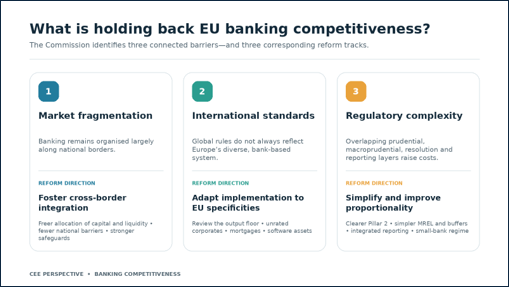
Figure 1. The Commission’s proposed approach to EU banking competitiveness. Source: CEE Perspective illustration based on the European Commission Communication on the Competitiveness of the Banking Sector and the Single Market in Banking, 17 July 2026.
The Commission plans to address these challenges through legislative and non-legislative measures to be presented in the first quarter of 2027.
Europe’s banking market remains fragmented
Despite a common EU rulebook and the development of the Banking Union, retail and corporate banking remain predominantly national. The Staff Working Documentshows that cross-border corporate lending represents approximately 16% of total corporate lending within the euro area. Cross-border bank mergers have also declined significantly, while most consolidation since the global financial crisis has occurred within national markets.
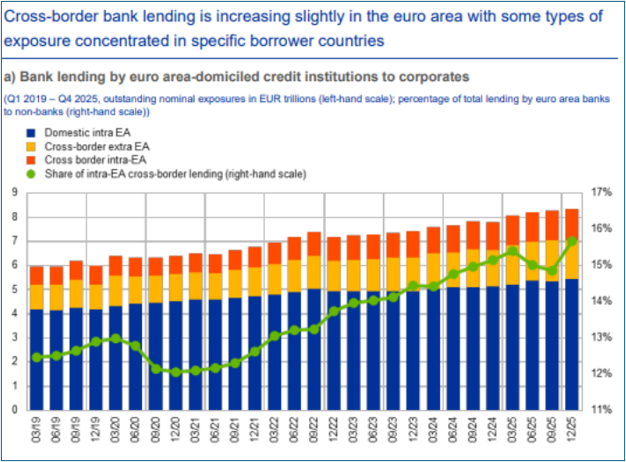
Figure 2. Cross-border corporate lending within the euro area. Source: ECB response to the Commission’s targeted consultation, reproduced in European Commission, Staff Working Document accompanying the Communication on the Competitiveness of the Banking Sector and the Single Market in Banking, SWD(2026) 615 final, Figure 20, p. 29.
One central issue is the treatment of capital and liquidity within cross-border groups. Banks must generally meet requirements both at group level and at the level of individual subsidiaries. According to an ECB estimate cited in the Staff Working Document, the transferability of approximately EUR 230 billion in high-quality liquid assets is constrained by the application of liquidity requirements at Member State level.
The Commission will propose measures allowing capital and liquidity to be allocated more efficiently. Group-wide supervisors would be able to ensure that requirements are met at parent level while requiring parent banks to provide subsidiaries with sufficient resources in a timely and enforceable manner, including during periods of stress.
Why the host-country debate matters for CEE
This debate is particularly relevant for CEE, where banking sectors in many countries are closely integrated with parent groups based elsewhere in the EU. The Staff Working Document confirms that lending through subsidiaries and branches of cross-border groups is particularly significant in CEE Member States.
National authorities remain responsible for domestic financial stability and may be reluctant to allow locally held resources to be managed more freely at group level. The central question is whether resources that move more easily across borders can also be returned to subsidiaries when needed.
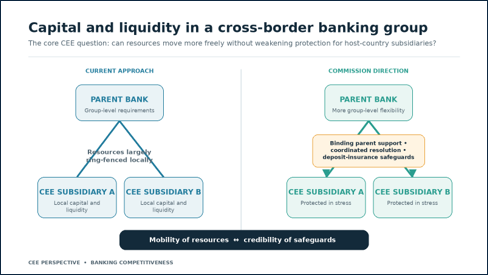
Figure 3. Capital and liquidity within a cross-border banking group. Source: CEE Perspective illustration based on the European Commission Communication on the Competitiveness of the Banking Sector and the Single Market in Banking, 17 July 2026.
The Commission recognises the risk that subsidiaries could face shortages during a crisis, leaving national authorities or deposit-guarantee schemes to manage the consequences. It will replace its 2015 European Deposit Insurance Scheme proposal with a new initiative intended to simplify the deposit-insurance framework and ensure that cross-border bank failures do not create liabilities for national schemes or public budgets.
Further measures will improve group-resolution strategies and liquidity backstops. The Commission has also committed to considering the different institutional arrangements of countries outside the Banking Union - an important point for several CEE Member States.
Simplification could bring tangible gains
The Commission will propose a simpler regime for small and less complex banks, potentially adjusting the criteria and thresholds used to identify them. This could benefit smaller domestic institutions that face many of the same regulatory processes as much larger groups.
The Communication also targets overlaps between prudential, resolution and macroprudential requirements. Planned measures include revising MREL, simplifying macroprudential buffers, improving coordination between authorities and making Pillar 2 guidance more targeted. Although this could improve capital planning, greater harmonisation may reduce national discretion to respond to domestic risks and credit cycles.
Reporting is another priority. Annual reporting costs for EU banks have been estimated at EUR 11.2 billion, while recent and planned EBA measures are expected to reduce reporting data points by 50%. The Commission supports more integrated and automated reporting, which could particularly benefit smaller institutions with limited compliance and IT resources.
Financing CEE businesses and supporting bank investment
The Commission will make proposals on the Basel output floor, including its effects on unrated companies and mortgage lending. This matters for CEE because SMEs and mid-sized companies remain heavily dependent on bank finance and often lack external credit ratings. Higher capital requirements for unrated exposures could increase borrowing costs even where banks have detailed knowledge of local companies. It will also examine specialised lending, including project finance for infrastructure and the energy transition, as well as trade finance. These areas are particularly relevant to CEE’s substantial infrastructure and investment needs.
Looking ahead
For CEE, the Commission’s agenda presents a genuine opportunity. More proportionate rules, lower reporting burdens and a framework better adapted to bank-financed companies could support lenders and the real economy.
However, the benefits will depend on whether greater flexibility for cross-border groups is matched by credible safeguards for host countries. The central challenge will be to make capital and liquidity more mobile without weakening financial-stability protections where lending and deposits are located.
Key takeaways
The Commission is preparing legislative and non-legislative measures focused on banking integration, implementation of international standards and regulatory simplification, to be presented in Q1 2027.
CEE could benefit from lower compliance costs, greater proportionality and a prudential framework better adapted to unrated companies, project finance and other forms of bank-dependent investment.
The most sensitive regional issue will be whether greater flexibility within cross-border groups is matched by enforceable parental-support obligations and credible safeguards for host countries.
Article Content
Introduction
The European Commission’s Communication on the competitiveness of the EU banking sector sets out an ambitious agenda to reduce fragmentation, simplify regulation and make it easier for banking groups to operate across borders. For Central and Eastern Europe (CEE), the reforms could support lending and lower compliance costs. However, moves to manage capital and liquidity more flexibly within cross-border groups also raise important questions for host countries that rely heavily on subsidiaries of foreign banking groups.
Setting the scene: a new competitiveness agenda for EU banking
On 17 July, the European Commission published its Communication on the competitiveness of the EU banking sector and the Single Market in banking, accompanied by a detailed Staff Working Document. It concludes that European banks have become more resilient and profitable over the past 15 years but remain constrained by national fragmentation, insufficient consideration of EU specificities when implementing international standards and an increasingly complex regulatory framework.
The Communication links banking competitiveness directly to the Savings and Investments Union. A more competitive banking sector is presented not as an alternative to deeper capital markets, but as a necessary part of financing innovation, defence and the green and digital transitions.
Figure 1. The Commission’s proposed approach to EU banking competitiveness. Source: CEE Perspective illustration based on the European Commission Communication on the Competitiveness of the Banking Sector and the Single Market in Banking, 17 July 2026.
The Commission plans to address these challenges through legislative and non-legislative measures to be presented in the first quarter of 2027.
Europe’s banking market remains fragmented
Despite a common EU rulebook and the development of the Banking Union, retail and corporate banking remain predominantly national. The Staff Working Documentshows that cross-border corporate lending represents approximately 16% of total corporate lending within the euro area. Cross-border bank mergers have also declined significantly, while most consolidation since the global financial crisis has occurred within national markets.
Figure 2. Cross-border corporate lending within the euro area. Source: ECB response to the Commission’s targeted consultation, reproduced in European Commission, Staff Working Document accompanying the Communication on the Competitiveness of the Banking Sector and the Single Market in Banking, SWD(2026) 615 final, Figure 20, p. 29.
One central issue is the treatment of capital and liquidity within cross-border groups. Banks must generally meet requirements both at group level and at the level of individual subsidiaries. According to an ECB estimate cited in the Staff Working Document, the transferability of approximately EUR 230 billion in high-quality liquid assets is constrained by the application of liquidity requirements at Member State level.
The Commission will propose measures allowing capital and liquidity to be allocated more efficiently. Group-wide supervisors would be able to ensure that requirements are met at parent level while requiring parent banks to provide subsidiaries with sufficient resources in a timely and enforceable manner, including during periods of stress.
Why the host-country debate matters for CEE
This debate is particularly relevant for CEE, where banking sectors in many countries are closely integrated with parent groups based elsewhere in the EU. The Staff Working Document confirms that lending through subsidiaries and branches of cross-border groups is particularly significant in CEE Member States.
National authorities remain responsible for domestic financial stability and may be reluctant to allow locally held resources to be managed more freely at group level. The central question is whether resources that move more easily across borders can also be returned to subsidiaries when needed.
Figure 3. Capital and liquidity within a cross-border banking group. Source: CEE Perspective illustration based on the European Commission Communication on the Competitiveness of the Banking Sector and the Single Market in Banking, 17 July 2026.
The Commission recognises the risk that subsidiaries could face shortages during a crisis, leaving national authorities or deposit-guarantee schemes to manage the consequences. It will replace its 2015 European Deposit Insurance Scheme proposal with a new initiative intended to simplify the deposit-insurance framework and ensure that cross-border bank failures do not create liabilities for national schemes or public budgets.
Further measures will improve group-resolution strategies and liquidity backstops. The Commission has also committed to considering the different institutional arrangements of countries outside the Banking Union - an important point for several CEE Member States.
Simplification could bring tangible gains
The Commission will propose a simpler regime for small and less complex banks, potentially adjusting the criteria and thresholds used to identify them. This could benefit smaller domestic institutions that face many of the same regulatory processes as much larger groups.
The Communication also targets overlaps between prudential, resolution and macroprudential requirements. Planned measures include revising MREL, simplifying macroprudential buffers, improving coordination between authorities and making Pillar 2 guidance more targeted. Although this could improve capital planning, greater harmonisation may reduce national discretion to respond to domestic risks and credit cycles.
Reporting is another priority. Annual reporting costs for EU banks have been estimated at EUR 11.2 billion, while recent and planned EBA measures are expected to reduce reporting data points by 50%. The Commission supports more integrated and automated reporting, which could particularly benefit smaller institutions with limited compliance and IT resources.
Financing CEE businesses and supporting bank investment
The Commission will make proposals on the Basel output floor, including its effects on unrated companies and mortgage lending. This matters for CEE because SMEs and mid-sized companies remain heavily dependent on bank finance and often lack external credit ratings. Higher capital requirements for unrated exposures could increase borrowing costs even where banks have detailed knowledge of local companies. It will also examine specialised lending, including project finance for infrastructure and the energy transition, as well as trade finance. These areas are particularly relevant to CEE’s substantial infrastructure and investment needs.
Looking ahead
For CEE, the Commission’s agenda presents a genuine opportunity. More proportionate rules, lower reporting burdens and a framework better adapted to bank-financed companies could support lenders and the real economy.
However, the benefits will depend on whether greater flexibility for cross-border groups is matched by credible safeguards for host countries. The central challenge will be to make capital and liquidity more mobile without weakening financial-stability protections where lending and deposits are located.
Key takeaways
The Commission is preparing legislative and non-legislative measures focused on banking integration, implementation of international standards and regulatory simplification, to be presented in Q1 2027.
CEE could benefit from lower compliance costs, greater proportionality and a prudential framework better adapted to unrated companies, project finance and other forms of bank-dependent investment.
The most sensitive regional issue will be whether greater flexibility within cross-border groups is matched by enforceable parental-support obligations and credible safeguards for host countries.