Newsletter 29 June 2026

CEE Perspective Weekly Digest- Issue 3

Your weekly round-up of banking, finance and EU policy with a CEE lens

CEE Perspective Weekly Digest- Issue 3

What's on the table this week

This week was marked by a strong focus on competitiveness across the European policy agenda. From tax simplification and capital markets integration to reforms of occupational pensions and sustainable finance, policymakers are seeking to mobilise investment and strengthen Europe's long-term growth potential. For Central and Eastern Europe, these developments will play an important role in supporting economic convergence, investment and the green and digital transitions.

Recent Key EU Developments

1
29 June

Commission assesses euro readiness of remaining non-euro Member States

The European Commission published its 2026 Convergence Report, assessing the progress of Czechia, Hungary, Poland, Romania and Sweden towards adopting the euro. The report concludes that none of the five Member States currently fulfils all the Maastricht convergence criteria, with the absence of participation in the Exchange Rate Mechanism (ERM II) remaining the principal obstacle. While Czechia and Sweden meet several of the economic convergence criteria, the Commission also identifies macroeconomic and institutional challenges that need to be addressed to ensure sustainable euro area membership.


Why it matters for CEE

The report highlights that euro adoption remains an important long-term objective for several Central and Eastern European economies, offering benefits through deeper economic integration and greater financial stability. At the same time, the findings underline that sustainable convergence extends beyond meeting technical criteria, requiring resilient public finances, strong institutions and a stable macroeconomic environment. For the region, the pace of euro adoption is therefore likely to continue reflecting domestic economic conditions and political priorities as much as formal convergence requirements. 

European Commission unveils €8 billion tax simplification package

On 24 June, the European Commission presented a major tax simplification package designed to reduce compliance costs, strengthen the Single Market and boost EU competitiveness. The package includes a Direct Taxation Omnibus and a recast of the Directive on Administrative Cooperation (DAC), with estimated annual savings of around €7.9 billion for businesses. Key measures include abolishing withholding taxes on certain intra-EU cross-border payments, extending withholding tax exemptions to pension institutions under the Parent-Subsidiary Directive, simplifying corporate tax rules and reducing tax reporting obligations.


Why it matters for CEE

The package could reduce compliance costs for businesses operating across borders, particularly in smaller and more open Central and Eastern European economies. Extending withholding tax exemptions to pension institutions and simplifying cross-border tax rules may also facilitate long-term investment and support the Savings and Investments Union. However, the proposals require unanimous approval in the Council, meaning negotiations could be lengthy and implementation may vary across Member States.


Council agrees position on SFDR reform

The Council of the European Union adopted its General Approach on the review of the Sustainable Finance Disclosure Regulation (SFDR), marking an important step towards reforming the EU sustainable finance framework. The Council supports replacing the current Article 8 and 9 classifications with three new product categories - Sustainable, Transition and ESG Basics - to improve comparability, reduce greenwashing risks and provide greater legal certainty. The compromise also clarifies the treatment of pension products and sovereign debt, introduces mandatory sustainability indicators, and simplifies the framework for products marketed exclusively to professional investors.


Why it matters for CEE

The reform seeks to make sustainable finance rules more practical while preserving investor confidence. If implemented effectively, the new framework could facilitate sustainable investment and support capital market development across the region. However, firms will also need to adapt to new product categories and disclosure requirements, which may prove more challenging for smaller markets with more limited resources.


Council advances work on Market Integration and Supervision Package

The Cyprus Presidency published a Progress Report on the Market Integration and Supervision Package (MISP), confirming substantial technical progress while highlighting several politically sensitive issues that remain unresolved. Discussions continue on the scope of direct ESMA supervision, the governance of ESMA's proposed Executive Board, the future of trading markets, post-trade infrastructure, asset management rules and the expansion of the DLT Pilot Regime. The Irish Presidency will now seek to bridge remaining differences and advance the Council towards a negotiating position.


Why it matters for CEE

The package has the potential to improve cross-border investment, market liquidity and access to capital by further integrating Europe's capital markets. At the same time, negotiations highlight concerns shared by several Member States that a more centralised supervisory framework should not come at the expense of national expertise or impose disproportionate costs on smaller financial markets and market infrastructures. Striking the right balance between greater integration and proportionality will therefore be particularly important for the region.


Council agrees position on IORP II review

On 26 June, the Council of the European Union adopted its negotiating position on the review of the IORP II Directive, paving the way for interinstitutional negotiations with the European Parliament. The proposal seeks to strengthen the framework for occupational pension funds by improving transparency, enhancing risk management, facilitating cross-border activity and removing barriers to long-term investment. The Council maintains key elements of the Commission's proposal while preserving Member States' flexibility through a minimum harmonisation approach and simplifying several administrative and supervisory requirements.


Why it matters for CEE

The review could support the further development of occupational pensions in Central and Eastern Europe by facilitating cross-border pension provision, encouraging long-term investment and helping mobilise additional capital for European capital markets. At the same time, the region's pension systems remain highly diverse, with occupational pensions playing a limited role in several Member States. Preserving national flexibility will therefore be essential to ensure the revised framework accommodates different levels of market development while supporting the gradual expansion of funded pension systems.
CEE Policy Radar

1
29 June

Twelve CEE countries call for stronger EU support for the energy transition

Twelve EU Member States - Bulgaria, Croatia, Czechia, Estonia, Greece, Hungary, Latvia, Lithuania, Poland, Romania, Slovakia and Slovenia - have called on the European Commission to extend and strengthen the Modernisation Fund beyond 2030. According to a joint letter seen by Euronews, the countries argue that the Fund has become an essential instrument for financing the transition to cleaner energy systems, strengthening energy security and supporting economic competitiveness. They are also calling for a significant increase in funding ahead of the forthcoming review of the EU Emissions Trading System (ETS). 

The Modernisation Fund, financed through revenues from the EU ETS, supports investments in modernising energy systems and improving energy efficiency in lower-income Member States. The initiative reflects growing concerns among Central and Eastern European countries that the region will continue to require substantial investment to decarbonise its economies while maintaining industrial competitiveness and affordable energy. The European Commission is expected to present its ETS review proposal on 15 July. 

ECB highlights uneven progress towards euro adoption across Central and Eastern Europe

The European Central Bank (ECB) has published its 2026 Convergence Report, assessing whether the five remaining EU Member States committed to adopting the euro meet the necessary economic and legal conditions. The report concludes that none of the countries- Czechia, Hungary, Poland, Romania and Sweden-currently fulfils all the requirements for euro adoption, with the absence of participation in the Exchange Rate Mechanism (ERM II) remaining the main obstacle. 

Among the Central and Eastern European countries assessed, Czechia performs the strongest, meeting the inflation, fiscal and long-term interest rate criteria. By contrast, Hungary, Poland and Romania continue to face more significant challenges, including high inflation or fiscal deficits, elevated borrowing costs and structural weaknesses. The ECB concludes that sustainable convergence will require not only meeting the Maastricht criteria but also maintaining sound public finances, implementing structural reforms and strengthening long-term economic resilience.

International banks remain committed to expanding in Central and Eastern Europe

The European Investment Bank's latest CESEE Bank Lending Survey indicates that international banking groups continue to view Central, Eastern and South-Eastern Europe as an attractive long-term growth market. Around three-quarters of parent banks plan to expand their presence in the region, while none intend to reduce their operations. Banks also report strong credit demand from households and businesses, favourable funding conditions and improved credit quality, although they expect lending conditions to soften slightly over the coming months. Market potential is considered particularly strong in Czechia, Romania and Slovakia, while profitability in the region continues to exceed that of banks' overall group operations in several CESEE countries. 

World Bank: AI could boost Poland's economy by up to 12% by 2035

A new World Bank report estimates that artificial intelligence could increase Poland's real GDP by between 1.3% and 12.1% by 2035, depending on the pace of AI adoption, investment and workforce adaptation. The report concludes that Poland is well positioned to benefit from AI but stresses that realising these gains will require investment in digital infrastructure, skills, innovation and a supportive regulatory environment. It also highlights the importance of reskilling policies and labour market reforms to ensure that the benefits of AI-driven growth are broadly shared. 

OECD urges Slovakia to accelerate reforms to strengthen long-term growth

The OECD's latest Economic Survey of the Slovak Republic warns that the country's export-led manufacturing model is facing increasing pressure from global trade tensions, demographic change and fiscal constraints. While growth is expected to recover gradually over the coming years, the OECD argues that stronger public finances and structural reforms will be essential to boost productivity, employment and long-term competitiveness. Key recommendations include improving the business environment, strengthening skills and innovation, reforming pensions and labour markets, and accelerating the adoption of artificial intelligence across the economy. For Slovakia, strengthening productivity, supporting innovation and adapting to demographic change will be critical to maintaining competitiveness in an increasingly challenging global environment.

This Week's Events to Watch

1
29 June

29 June – Employment, Social Policy, Health and Consumer Affairs (EPSCO) Council: Employment and social affairs ministers will discuss the European Semester Spring Package, fair labour mobility and the recently proposed EU Anti-Poverty Strategy. Ministers are also expected to adopt Council conclusions on housing, focusing on the impact of demographic change on housing affordability and long-term policy planning.

1 July – Ireland assumes the Presidency of the Council of EU.

2 July – European Parliament ECON Committee: MEPs will hold a Monetary Dialogue with ECB Supervisory Board Chair Claudia Buch and discuss the Market Integration and Supervision Package (MISP). The Committee will also consider the proposed EU-UK Competition Cooperation Agreement.

2 July – European Commission College Meeting: The Commission is expected to adopt a Communication on the Defence Single Market, setting out measures to strengthen Europe's defence technological and industrial base as part of the EU's broader competitiveness and strategic autonomy agenda.

2 July – European Parliament Joint Committee Vote (ECON/LIBE/ENVI): MEPs are expected to vote on the Omnibus IV simplification package, which extends certain regulatory simplification measures to small mid-cap companies as part of the Commission's broader competitiveness agenda.

2–3 July – Visit of the College of Commissioners to Ireland: The College of Commissioners will travel to Cork to meet the Irish Government at the start of Ireland's Presidency of the Council of the EU. Discussions will focus on the Irish Presidency's priorities, including competitiveness, the Savings and Investments Union and broader economic and strategic policy objectives for the second half of 2026.

CEE Perspective Updates

3

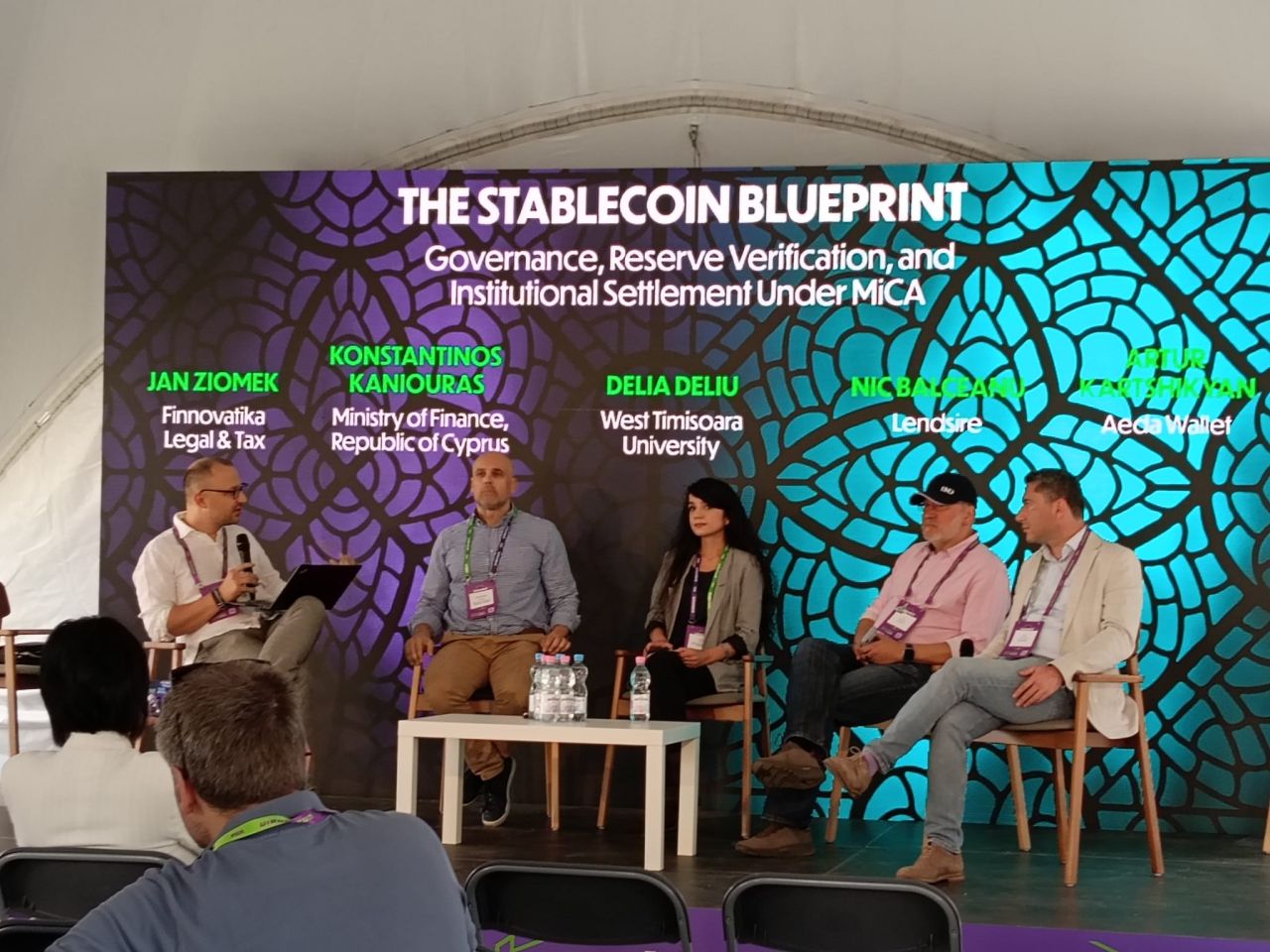
CEE Perspective at UNCHAIN Festival 2026: Stablecoins, Governance and Trust under MiCA

CEE Perspective was pleased to host a Focus Stage panel at UNCHAIN Festival 2026, held on 17–18 June at the historic Oradea Fortress in Romania. The festival brought together more than 900 participants from over 40 countries, including representatives from national banks, regulators, commercial banks, fintech companies and technology providers. 

Our panel, “The Stablecoin Blueprint: Governance, Reserve Verification, and Institutional Settlement Under MiCA,” focused on the practical questions now surrounding digital assets in Europe. As MiCA begins to shape the regulatory environment, stablecoins are no longer only a technology discussion. They are also a question of governance, verification, settlement, institutional responsibility and trust. 

The discussion looked in particular at reserve verification and proof-of-reserves. While proof-of-reserves can provide useful information, it does not by itself answer every question around liabilities, control, timing, legal claims or operational resilience. For regulated institutions, this distinction matters. A dashboard may show visibility, but visibility alone is not the same as assurance. 

CEE Perspective was represented by Delia DELIU and Konstantinos Kaniouras, who contributed to the panel with strong expertise on the regulatory, market and institutional dimensions of digital assets. 

We thank UNCHAIN Festival for welcoming CEE Perspective to this year’s edition and for creating a valuable platform for financial-sector dialogue in Central and Eastern Europe.

1782206981023.jpg

29 June

CEE Annual Payments Forum 2026: session recordings now available

It has already been a month since the CEE Annual Payments Forum took place at the National Bank of Romania in Bucharest. 

On 26 May, the Forum brought together regulators, banks, payment institutions, technology companies, infrastructure providers and policy experts for a full day of discussion on Europe’s payments agenda from a Central and Eastern European perspective. 

The programme covered PSD3 and PSR, open finance, instant payments, liquidity management, operational resilience, AI in payments, cybersecurity, digital identity, cash in crisis situations and trust in digital finance. 

For those who would like to revisit the sessions, or catch up on the discussions they missed, the recordings are now available on the CEE Perspective YouTube channel.

 You can now watch all sessions from the CEE Annual Payments Forum 2026 online.


CEE Annual Payments Forum 2026: session recordings now available Watch
29 June

New CEE Perspective publication on the Savings and Investments Union

CEE Perspective has published a new article, “Can the Savings and Investments Union close CEE’s investment gap?”, examining what the EU’s Savings and Investments Union could mean for Central and Eastern Europe. 

The publication looks at a question that is central for the region: can Europe’s large pool of household savings be channelled towards the markets where investment needs remain most visible? For CEE, the SIU could support deeper capital markets, improve access to private investment and help businesses, SMEs and scale-ups find stronger financing options. At the same time, the article underlines that the benefits of financial integration will not be automatic, especially for smaller and less liquid markets. 

Read the full article and explore all CEE Perspective publications on our website.

cover-image-siu-article.jpg

Read more

Also On Our Radar

1
  • The Council adopted its negotiating position on the review of the Pan-European Personal Pension Product (PEPP), supporting measures to simplify distribution, remove the 1% fee cap and make the product more commercially attractive. The European Parliament is expected to begin examining the file in July, with the draft report scheduled to be presented in the ECON Committee on 15 July.

  •       EIOPA published its June 2026 Financial Stability Report, concluding that European insurers and occupational pension funds remain resilient despite heightened market volatility. The report identifies demographic change, geopolitical uncertainty, cyber risks and the development of the Savings and Investments Union as key themes shaping the sector's long-term outlook.

  •       The European Parliament's ECON Committee has endorsed the provisional agreements on the Retail Investment Strategy (RIS), paving the way for formal adoption by the Parliament later this year. The package introduces updated retail investor protection rules, including simplified advice for certain investment products, stronger safeguards for online investors and enhanced transparency requirements.

  •       The European Banking Authority (EBA) updated its Pillar 3 disclosure framework, introducing proportionate ESG disclosure requirements for all institutions while significantly reducing reporting obligations. The revised standards adopt a simplified "core plus supplement" approach, remove taxonomy-related disclosures and are expected to apply from the end of 2026, subject to European Commission approval.

  •       The European Commission published its 2025/2026 Annual Report on European SMEs, showing that Europe's 34 million SMEs continued to grow in 2025 despite recent economic challenges. The report identifies productivity growth, innovation and targeted policy support as key priorities for strengthening the competitiveness of Europe's small and medium-sized enterprises.

  •      The European Parliament's ECON Committee adopted its negotiating position on the Single Currency Package, including the digital euro proposal. The Parliament supports free basic digital euro services, broad distribution through regulated payment service providers and safeguards for cash acceptance, with interinstitutional negotiations expected to begin following the July plenary.

  •       The European Commission disbursed €2.25 billion to Romania under the Recovery and Resilience Facility (RRF), marking the country's fourth payment under NextGenerationEU. The funding supports reforms and investments across areas including tax administration, pensions, healthcare, education, digitalisation, transport and energy, bringing total disbursements to over 60% of Romania's allocated funding. With the RRF due to conclude at the end of 2026, Member States now face a limited window to complete remaining milestones and secure their outstanding payments.