
Newsletter 6 July 2026

CEE Perspective Weekly Digest - Issue 4

Your weekly round-up of banking, finance and EU policy with a CEE lens

CEE Perspective Weekly Digest - Issue 4

What's on the table this week

As the Irish Presidency gets underway, the EU policy agenda is entering a more delivery-focused phase. In financial services, sustainable finance and digital regulation alike, the emphasis is shifting away from launching new initiatives and towards implementation, simplification and political agreement. That shift is visible in the first signals from Dublin, in the Council’s adoption of the AI Omnibus and in the latest efforts to streamline Taxonomy disclosures. For Central and Eastern Europe, however, this agenda is landing against a more uneven economic backdrop. While developments in Romania, Montenegro, Ukraine and the region’s venture financing landscape underline CEE’s strategic relevance to Europe’s broader push on investment, resilience and growth, they also highlight the widening divergence in reform momentum, financing capacity and economic performance across the region.

Recent Key EU Developments

1
6 July

Irish Presidency sets out ECOFIN priorities for the second half of 2026

The Irish Presidency published its draft ECOFIN agendas for the second half of 2026, offering an early indication of where it intends to focus Council work in financial services and taxation. On the financial services side, the main priority is the Market Integration and Supervision Package (MISP), with ministers expected to hold a policy debate in July and the Presidency aiming for a general approach on 9 October. In taxation, the draft agendas point to political milestones on the tobacco taxation package in October and the recast of the Directive on Administrative Cooperation (DAC) in December, while also signalling readiness to take forward new Commission proposals if tabled. 

More broadly, the draft agendas suggest that the Irish Presidency wants to turn the second half of 2026 into a delivery phase for the EU’s financial services agenda, with the focus shifting from launching new initiatives to advancing the files already on the table through implementation, simplification and political agreement. The prominence given to MISP is particularly telling. More than any other live financial-services file, it sits at the heart of the EU’s current push to deepen capital markets, reduce supervisory fragmentation and make the Savings and Investments Union deliver in practice. How far the Irish Presidency can move the package forward will therefore be an important test of whether the EU is prepared to align its financial-services framework more closely with its broader competitiveness agenda.

 Why it matters for CEE

For Central and Eastern European stakeholders, the draft agendas offer an early map of the files most likely to shape the EU policy debate in the second half of the year. The prominence given to MISP is particularly relevant, as the package will influence the future balance between national and EU-level supervision, the functioning of capital markets and the conditions for cross-border market integration. The agenda also confirms that, after an intense first half of the year, the focus is now shifting from launching new initiatives to securing political agreements on the core competitiveness, capital markets and tax files that will matter for businesses and investors across the region. 

Council formally adopts AI Omnibus, confirming revised implementation timeline for the AI Act

The Council formally adopted the AI Omnibus Regulation, completing the legislative process for the simplification package and confirming a revised implementation timetable for the AI Act. The regulation delays the application of the AI Act’s high-risk rules to 2 December 2027 for stand-alone systems and 2 August 2028 for AI embedded in products. It also introduces earlier application dates for certain targeted safeguards, including the prohibition of AI systems generating non-consensual sexual deepfakes and AI-generated child sexual abuse material from December 2026, while clarifying the division of responsibilities between the AI Office and national authorities. 

Why it matters for CEE

The adoption of the AI Omnibus gives businesses and supervisors greater clarity on the timing of compliance with the AI Act and reflects the EU’s broader effort to balance regulatory ambition with operational feasibility. For Central and Eastern European economies, where AI adoption remains uneven but interest in digital innovation is growing, the longer implementation timeline may create additional space for firms, regulators and public authorities to prepare for the new framework. At the same time, the file illustrates a wider policy trend that will matter for the region: the EU is increasingly willing to recalibrate digital rules in the name of competitiveness and simplification, without abandoning core safeguards altogether. 

ESAs launch consultation on simplifying EU Taxonomy disclosures

The European Supervisory Authorities have launched a consultation on technical advice to the Commission on possible simplifications to the EU Taxonomy disclosure framework. The exercise covers selected key performance indicators under the Taxonomy Disclosures Delegated Act and forms part of the broader simplification agenda. Among the proposals, ESMA suggests easing certain reporting requirements for non-financial undertakings and asset managers, including on operational expenditure and group-level reporting; EIOPA proposes simplifying the underwriting KPI for insurers and reducing some template disclosures; and the EBA recommends aligning certain grandfathering provisions with the EU Green Bond framework while clarifying group-level disclosures for financial institutions. The consultation runs until 12 August 2026. 

Why it matters for CEE

The consultation is particularly relevant for financial institutions and corporates in Central and Eastern Europe, as any simplification of the Taxonomy disclosure framework could be especially helpful for firms operating in smaller markets with more limited reporting capacity. If pursued, the proposed changes could make Taxonomy disclosures more proportionate and operationally manageable, particularly for firms with leaner compliance resources. More broadly, the review reflects an important shift in the EU sustainable finance agenda: the focus is no longer only on expanding disclosure requirements, but increasingly on making the framework simpler, more usable and more consistent with the Union’s wider competitiveness objectives.
CEE Policy Radar

1
6 July

Romania strengthens BID with €1bn capital increase and broader mandate

The European Commission approved a package of Romanian state aid measures to strengthen Banca de Investiții și Dezvoltare (BID), the country’s national investment and development bank. The measures include a €1 billion capital increase, partly financed through the Recovery and Resilience Facility, a three-year extension of the state guarantee backing the bank’s operations until the end of 2032, and a broader mandate allowing BID to support additional strategic sectors such as defence, high-tech manufacturing, knowledge-intensive industries and cybersecurity. According to the Commission, the package is intended to improve access to finance for projects and companies facing persistent market financing gaps, including innovative SMEs, start-ups and long-term infrastructure investments.

Beyond Romania, the decision reflects the growing role of national development banks across Central and Eastern Europe as vehicles for mobilising long-term investment, absorbing EU funds and supporting strategic sectors where private financing remains limited. It reinforces the role of BID as a vehicle for channelling long-term public-backed financing into areas where private capital remains scarce, particularly infrastructure, innovation and strategic industrial capacity. More broadly, it reflects a wider trend across Central and Eastern Europe where national development institutions are becoming increasingly important tools for mobilising investment, absorbing EU funds and supporting industrial and technological upgrading in economies where capital markets remain relatively shallow. 

wiiw forecasts resilient but increasingly uneven growth across Central and Eastern Europe

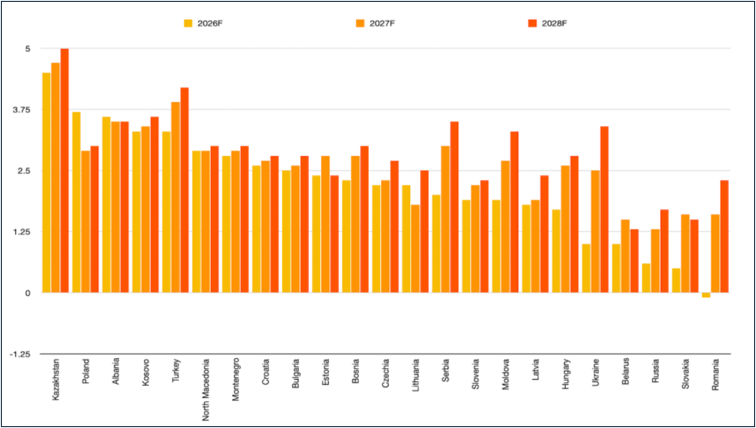
The Vienna Institute for International Economic Studies (wiiw) published its summer forecast for Central, East and Southeast Europe, expecting the region’s economies to remain broadly resilient despite the recent energy price shock linked to the Iran conflict. For the eastern EU member states, wiiw projects average growth of 2.2% in 2026, supported mainly by private consumption, EU funds and defence-related investment. At the same time, the institute warns that higher energy prices are likely to keep inflation elevated and that structural challenges, including weak industrial competitiveness and lower foreign investment, continue to weigh on the region. 

The outlook remains uneven across Central and Eastern Europe. Romania is expected to contract slightly this year amid fiscal consolidation and political uncertainty, while Slovakia is forecast to post only modest growth. Poland remains the strongest performer among the eastern EU member states, and Hungary is expected to recover gradually from recent stagnation. The forecast highlights both the resilience of the region and the growing divergence between CEE economies as they face a more difficult external environment.

picture2-1783335819.png

Source: The Vienna Institute for International Economic Studies (wiiw), Summer Forecast, 1 July 2026. 

Orbit Capital raises €107mn growth debt fund to support CEE scale-ups

Czech venture debt investor Orbit Capital reached a €107 million second close for its Growth Debt Fund II, exceeding its initial fundraising target and expanding the pool of non-dilutive financing available to later-stage technology companies in Central and Eastern Europe. The fund targets post-Series A businesses with at least €3 million in annual revenue and strong growth potential, offering ticket sizes of €3–15 million to support expansion, acquisitions and working capital. Reported investors include the European Investment Fund (EIF), Rentea, Česká spořitelna/Erste, Conseq and PFR Ventures, with the latter making its first investment in venture debt.

The fundraising is a notable signal for the gradual development of alternative growth financing in the region. Venture debt remains a relatively underdeveloped segment of CEE capital markets, but growing participation from institutional investors suggests increasing confidence in the asset class and in the region’s scale-up ecosystem. More broadly, the fund reflects a structural challenge that continues to shape CEE competitiveness: while the region has produced a growing number of innovative companies, access to long-term growth capital beyond early-stage venture funding remains limited, highlighting the need for deeper and more diversified capital markets across the region. 

Commission presents €3.2bn financial package for Montenegro’s future EU accession

The European Commission presented a financial package setting out the budgetary arrangements that would apply to Montenegro upon accession to the European Union. The package is intended to support Montenegro’s transition from pre-accession assistance to full participation in EU funding and policies, while ensuring continuity and limiting administrative disruption. According to the Commission, it is designed to prepare Montenegro for participation in the EU budget both as a beneficiary and as a contributor, covering areas such as regional development, agriculture, social policy and home affairs under the framework of the next Multiannual Financial Framework. 

The proposal is another indication that Montenegro remains the most advanced enlargement candidate in the Western Balkans and that the EU is beginning to prepare more concretely for the budgetary and policy consequences of future enlargement. For the wider CEE region, it is also a reminder that enlargement is no longer only a geopolitical question but increasingly a practical one, requiring the EU to think in advance about how candidate countries will be integrated into common funding instruments, sectoral policies and the Single Market. 

Ukraine recovery conference underlines scale of reconstruction financing efforts

At the Ukraine Recovery Conference in Gdańsk, the European Commission signed agreements worth over €1.1 billion in new financing under the Ukraine Investment Framework, covering sectors central to Ukraine’s recovery and long-term growth, including defence, infrastructure and renewable energy. The Commission also launched the European Flagship Fund for the Reconstruction of Ukraine, with initial capital of €220 million and the potential to leverage up to €7 billion in investment. The conference also underlined Poland’s increasingly visible role in Ukraine’s recovery, both as co-host of the event and through the involvement of Polish public institutions and companies in reconstruction-related initiatives. The conference underlines both the scale of the financing effort now being mobilised around Ukraine’s reconstruction and the increasingly important role that Central and Eastern European actors are seeking to play in that process. 

More broadly, recent developments across Central and Eastern Europe point to a financing landscape that is becoming increasingly institution-driven. From Romania’s use of its national development bank and Montenegro’s accession-related financial planning to new venture debt raised for CEE scale-ups and the mobilisation of EU-backed reconstruction finance for Ukraine, public institutions, EU instruments and specialised investment vehicles are playing a growing role in channelling long-term capital into economies where domestic capital markets remain relatively shallow.

This Week's Events to Watch

1
6 July

6–9 July – European Parliament plenary session:MEPs will meet in Strasbourg for the July plenary session. On 7 July, Parliament is scheduled to debate the Irish Presidency’s programme of activities. The agenda also includes debates on the Competition Policy Annual Report 2025, the report on a coherent tax framework for the EU’s financial sector, and the own-initiative report on digital assets and the competitiveness of the EU financial system.

7 July – College of Commissioners meeting: The Commission is expected to discuss its forthcoming Action Plan on Cybersecurity and AI, as well as the Livestock Strategy. A trilogue meeting on the securitisation package is also scheduled to take place the same day.

8 July – Financial Services Committee (FSC):National finance ministry officials will meet in Brussels to take stock of the Cypriot Presidency’s achievements and discuss the Irish Presidency’s priorities in financial services. The agenda also includes the Commission’s approach to financial services in the 2026 European Semester, an ECB update on simplification, the state of play of AMLA implementation, a comparison of EU and US going-concern capital requirements, and updates from EIOPA on simplification and the follow-up to its first coordinated mystery shopping exercise.

9 July – Eurogroup: Euro area finance ministers will hold their first meeting under the Irish Presidency, ahead of the July ECOFIN Council and against the backdrop of wider discussions on economic governance, competitiveness and the euro area outlook.

9–10 July – Informal Competitiveness Council (Internal Market and Industry):EU ministers responsible for the internal market and industry will meet in Dublin for an informal Competitiveness Council focused on the Irish Presidency’s broader competitiveness agenda. Discussions are expected to centre on the “One Europe, One Market” agenda, with particular attention to the Single Market, cross-border barriers for SMEs and digital services.

10 July – Economic and Financial Affairs Council (ECOFIN): Finance ministers will meet in Brussels for the first ECOFIN meeting under the Irish Presidency. The Council will hold a policy debate on the Market Integration and Supervision Package (MISP), a key part of the EU’s Savings and Investments Union agenda, and will also hear the Irish Presidency’s work programme in economic and financial affairs. In addition, ministers are due to discuss economic governance and the excessive deficit procedure, approve the 2026 European Semester country-specific recommendations, exchange views on the economic and financial impact of Russia’s aggression against Ukraine, and adopt decisions on modified recovery and resilience plans.

CEE Perspective Updates

1
6 July

Save the date: CEE Perspective Academy webinar on Europe’s competitiveness agenda

CEE Perspective Academy will host an online webinar on 17 July 2026 titled “Europe’s Competitiveness Agenda: Capital, Convergence and the CEE Perspective.” Taking place immediately after the expected publication of the European Commission’s report on the competitiveness of the EU banking sector, the discussion will look at how Europe’s broader competitiveness agenda connects with capital mobilisation, financial sector capacity and the investment needs of Central and Eastern Europe. 

The webinar will bring together voices from EU institutions, the banking sector and the wider policy community to discuss what competitiveness means in practice for Europe’s financial architecture, and how CEE markets can be better reflected in the next phase of the debate. More details, including the full speaker line-up and registration link, will be announced soon. Stay tuned.

Also On Our Radar

1
6 July
  • The EBA launched a consultation on its draft methodology for setting fines under MiCA, setting out how sanctions for issuers of significant crypto-assets would be calibrated in a consistent and proportionate way. The consultation is open until 28 September 2026, with a public hearing scheduled for 16 July.

  • The EBA published a roadmap for implementing its mandates under the revised Deposit Guarantee Schemes Directive (DGSD3), setting out the delivery of 12 regulatory products in three phases between 2027 and 2029. The roadmap covers depositor information, information exchange, investment diversification, DGS financial means, cross-border cooperation and stress testing, ahead of the directive’s application in May 2028.

  • AMLA warned of heightened money laundering and terrorist financing risks linked to the end of the MiCAR transitional period on 1 July 2026, as unauthorised crypto-asset service providers are expected to exit the market or transfer customers to authorised entities. The Authority calls on both firms and supervisors to strengthen monitoring, governance and information-sharing during the transition.

  • New survey data suggest that economic sentiment across Central and Eastern Europe remains mixed at the start of the second half of 2026. According to Erste Group’s latest regional update, sentiment improved slightly in Croatia, Hungary and Poland in June, while Czechia, Romania and Serbia recorded a deterioration, with Romania seeing the sharpest weakening amid political uncertainty and a less supportive domestic backdrop.

  • Hungary is preparing to roll back parts of the restrictive crypto-asset regime introduced in 2025, including the requirement that crypto-to-fiat and crypto-to-crypto transactions be validated by a licensed third-party provider. According to recent reporting, the government plans to remove both the validation obligation and the related criminal penalties, bringing Hungary’s framework back into closer alignment with MiCA after several platforms curtailed services in the market.