
Renew Europe calls for stronger EU financial sovereignty
Renew Europe published a policy paper arguing that Europe should treat its financial infrastructure as a strategic asset and reduce its dependence on non-EU providers for payments, capital markets and financial services. Framing financial sovereignty as an issue of resilience rather than protectionism, the paper argues that the EU should be able to finance investment, process payments and support its economy even in a more fragmented geopolitical environment.
To achieve this, Renew proposes completing the Savings and Investments Union through deeper capital market integration, stronger European supervision, simplified cross-border investment rules and measures to channel more household savings into productive investment. The paper also calls for expanding the geographical reach of SEPA, implementing EMIR, extending TARGET2 operating hours, promoting euro-denominated stablecoins, encouraging more financial market infrastructure within the EU and reducing the impact of extraterritorial financial sanctions on European businesses.
Why it matters for CEE
The paper reflects a broader shift in EU financial policy, with capital markets, payment systems and market infrastructure increasingly viewed not only as economic tools but also as strategic assets that underpin Europe's competitiveness and resilience. For Central and Eastern Europe, further integration of European capital markets could improve access to long-term financing for businesses, strengthen cross-border investment and support the region's economic convergence.
Although the paper is not legislative, it provides an important indication of the policy priorities that Renew Europe is likely to promote in upcoming negotiations on the Savings and Investments Union, financial market infrastructure and the EU's broader competitiveness agenda. It also reinforces a wider trend in Brussels: financial policy is increasingly being shaped not only by efficiency and stability considerations, but also by geopolitical resilience and the EU's ambition to strengthen the international role of the euro.
SFDR negotiations delayed as Parliament seeks compromise on sustainability categories
The European Parliament has postponed its planned vote on the review of the Sustainable Finance Disclosure Regulation (SFDR), with the ECON Committee now expected to consider its position in September rather than July. The delay reflects ongoing negotiations on several politically sensitive aspects of the reform, particularly the design of the new sustainability categorisation framework and the balance between facilitating investment in the transition to a sustainable economy and maintaining robust safeguards against greenwashing.
While compromise amendments broadly support replacing the current Article 8 and Article 9 classifications with the proposed Sustainable, Transition and ESG Basics categories, significant differences remain over the treatment of fossil fuel-related activities, sovereign debt, mandatory principal adverse impact (PAI) disclosures and the sustainability safeguards applicable to products using the new labels. Compared with the Council's General Approach, Parliament appears to favour a more stringent approach, including stronger anti-greenwashing provisions, broader mandatory PAI reporting, tighter sustainability criteria and more limited recognition of sovereign debt within the new categorisation framework.
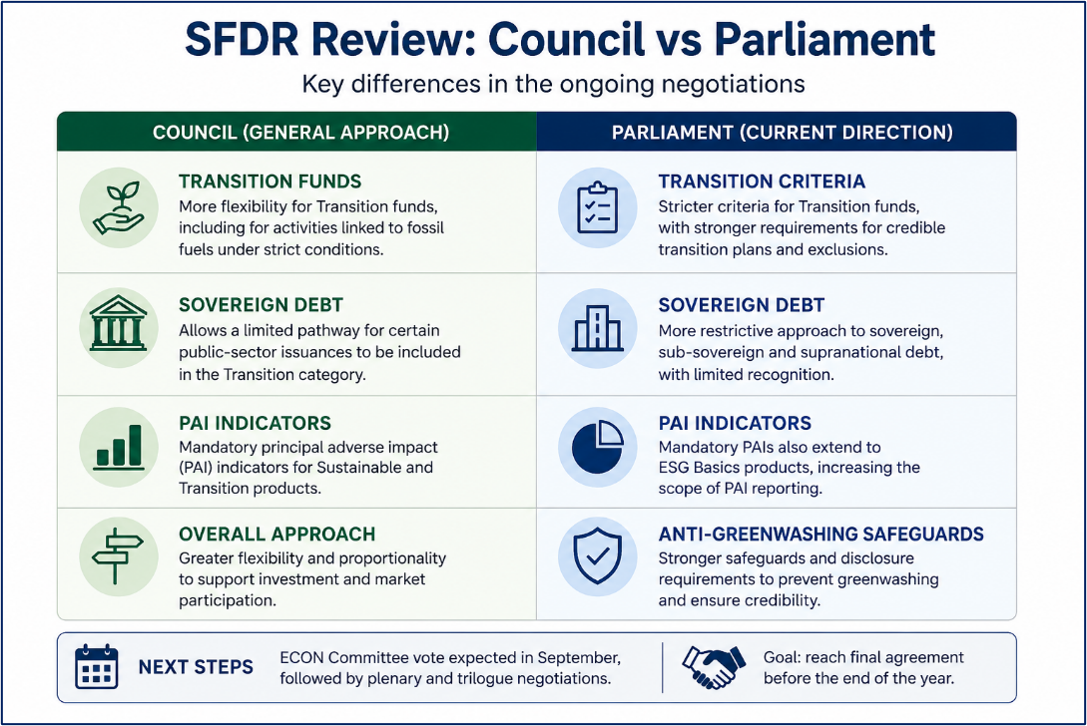
Source: CEE Perspective illustration based on the Council of the European Union, General Approach on the Proposal for a Regulation amending the Sustainable Finance Disclosure Regulation (24 June 2026) and the European Parliament ECON Committee technical compromise amendments on the SFDR Review (July 2026).
Why it matters for CEE
The postponement underlines that the final shape of the SFDR remains far from settled, despite broad political support for replacing the existing disclosure regime with a clearer product categorisation framework. The outcome of the negotiations will determine how sustainable investment products are classified and marketed across the EU, with implications for asset managers, institutional investors and capital markets more broadly.
For Central and Eastern Europe, several of the unresolved issues are particularly relevant. The treatment of sovereign debt could influence the role of government bonds within sustainable investment strategies, while stricter sustainability criteria and disclosure requirements may increase implementation costs for market participants operating in smaller or less mature financial markets. More broadly, the ongoing negotiations illustrate the challenge of striking a balance between strengthening investor confidence through robust sustainability standards and ensuring the framework remains sufficiently flexible to support investment in the transition to a more sustainable European economy.
Retail Investment Strategy moves towards final adoption
The Retail Investment Strategy (RIS) has moved a step closer to becoming law after the European Parliament's ECON Committee endorsed the provisional trilogue agreement reached with the Council. The endorsement follows several months of technical discussions between Member States on possible simplification measures, which delayed formal approval of the political agreement reached in late 2025. The package is now expected to be endorsed by the European Parliament in plenary on 11 November 2026, before its publication in the Official Journal later this year.
The reform seeks to strengthen retail investor protection while improving confidence in EU capital markets. At its core is a new Value for Money (VfM) framework requiring manufacturers to demonstrate that the costs and charges of investment products are justified in relation to their features, performance and target market. The agreement also modernises the PRIIPs Key Information Document (KID) by introducing a clearer "Product at a Glance" dashboard, enhanced digital disclosures and improved cost comparability for complex investment products. Other elements include revised suitability and appropriateness assessments, broader criteria for professional-client classification, new risk-warning requirements for particularly risky products and enhanced supervisory powers for ESMA and EIOPA to promote more consistent implementation across Member States.
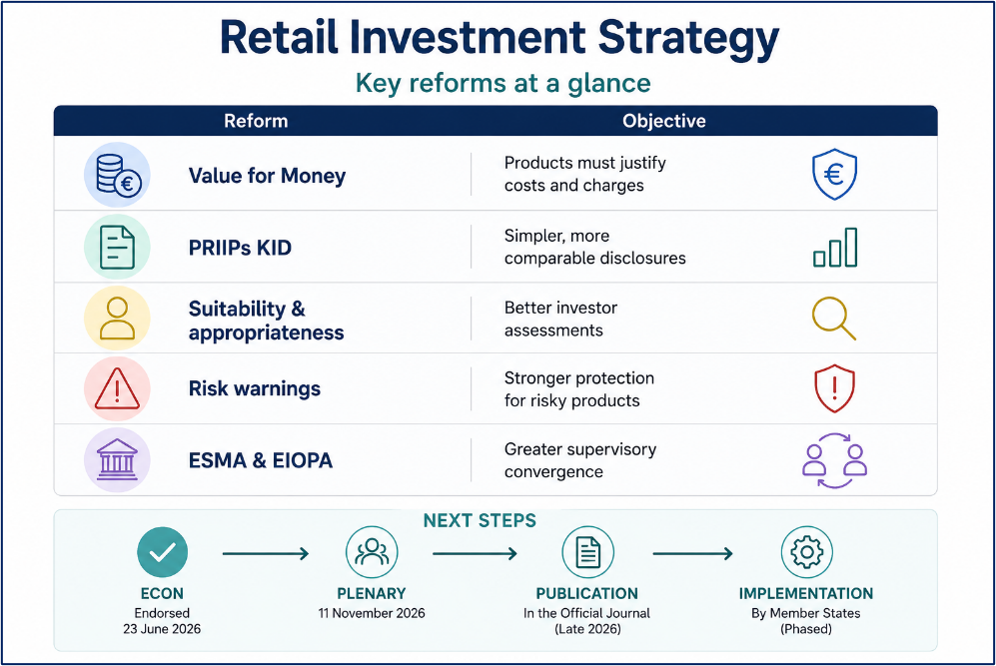
Source: CEE Perspective illustration based on the provisional trilogue agreement on the Retail Investment Strategy endorsed by the European Parliament ECON Committee (23 June 2026) and the European Commission Proposal for a Retail Investment Strategy (COM(2023) 279 final).
Why it matters for CEE
The RIS represents one of the most significant recent reforms affecting the EU retail investment market and forms part of the broader Savings and Investments Union agenda aimed at encouraging greater retail participation in capital markets. By improving transparency, comparability and supervisory convergence, the package seeks to make investment products easier for retail investors to understand and compare across the EU.
For Central and Eastern Europe, where household participation in capital markets generally remains below the EU average and savings continue to be concentrated in deposits, the reforms could support the gradual development of retail investment markets and greater cross-border distribution of financial products. At the same time, the new Value for Money framework and enhanced disclosure requirements will require firms to adapt product governance, pricing and reporting processes, making consistent implementation across Member States an important issue to monitor as the legislation enters the implementation phase.
Euro area banks tighten lending standards despite modest rebound in business loan demand
The European Central Bank's latest Bank Lending Survey, published on 21 July, shows that euro area banks continued to tighten credit standards for both businesses and households during the second quarter of 2026, reflecting heightened risk perceptions linked to the economic outlook, geopolitical uncertainty and energy developments. Credit standards tightened moderately for corporate lending, while banks also reported stricter conditions for mortgages and consumer credit. Looking ahead, banks expect lending standards to tighten further across all major loan categories in the third quarter.
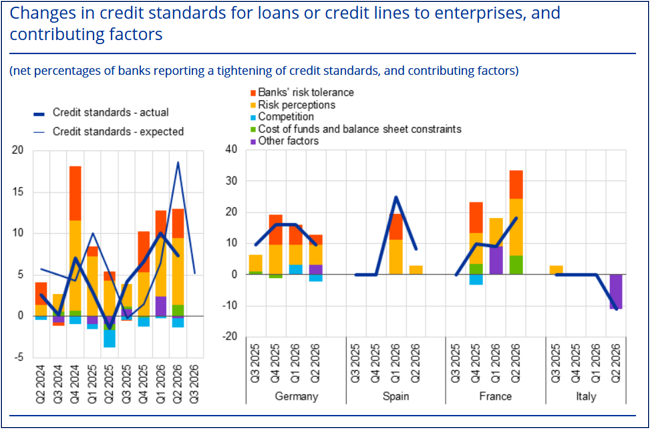
Source: European Central Bank, July 2026 euro area Bank Lending Survey, Chart 1 (21 July 2026).
Despite tighter lending conditions, demand for business loans increased slightly, supported by higher financing needs for inventories, working capital, fixed investment by large firms and debt refinancing. In contrast, demand for housing loans declined significantly and consumer credit continued to soften, reflecting weaker consumer confidence and the impact of interest rates. The survey also highlights a growing divergence in lending conditions across sectors, with the most pronounced tightening reported in energy-intensive manufacturing and the automotive industry, while firms investing in the green transition continued to benefit from more favourable lending conditions.
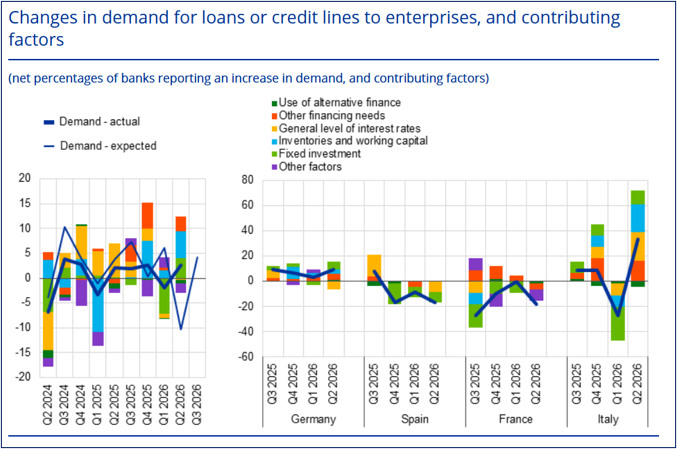
Source: European Central Bank (2026), July 2026 euro area Bank Lending Survey, Chart 2.